

Press release submitted on behalf of Gigahertz-Optik.
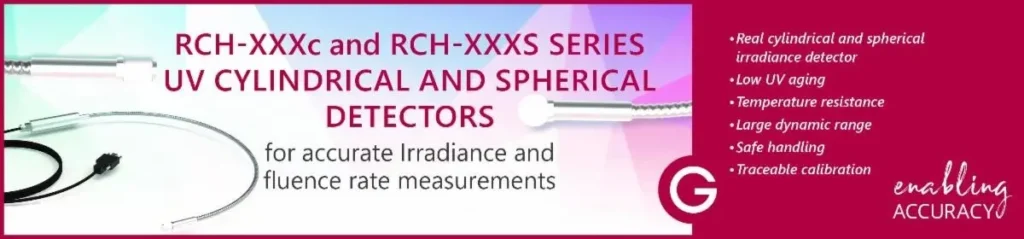
Gigahertz-Optik introduced the RCH-XXXs series detectors that are engineered for applications where precise measurement of spherical irradiance or fluence rate is essential, such as UV-C disinfection systems. Featuring a true spherical diffuser, the design ensures uniform detection of UV radiation from all spatial directions. The detectors boast high thermal resistance, minimal UV aging and long-term measurement stability. They come with a precise calibration allowing vision “enabling accuracy”.
The RCH-XXXc series is tailored for cylindrical irradiance measurements and is ideal for UV curing processes involving multiple light sources or 360° exposure geometries. Equipped with a cylindrical diffuser, the sensor delivers consistent readings around its entire surface. These detectors also support ISO-traceable calibration and are optimized for environments where spatial averaging is critical to performance assessment.
Both series are compatible with Gigahertz-Optik’s modular measurement systems and support a variety of UV spectral ranges, including UV-A, UV-B and UV-C. Their robust design and precision make them suitable for industries like healthcare, semiconductor manufacturing, UV LED testing and environmental monitoring.
The measurement range of the radiometer will depend on the detector specifications and those of the particular meter.
For example, the X1 Radiometer with RCH-122s for 254nm will measure from an NEI of 1.2 μW/cm2 to a maximum of 50 W/cm2.
The detectors can be used in combination with any Gigahertz-Optik filter radiometer. For the widest dynamic range, the P-21 Radiometer is recommended. Adaptation of the detector to work with existing radiometers should be discussed with the factory.
All RCH type detectors are uniquely designed to withstand and remain stable in high-intensity UV and heat environments. The sensitive components (bandpass filter and photodiode) are encapsulated upstream from the irradiation zone. A light guide connects the filter detector capsule to the input optic, directing the optical radiation piped through to it at much lower intensity.
Note that both rigid and flexible fiber light guide versions are available.
For more information, visit www.gigahertz-optik.com.