

By Nabiha Ben Sedrine, Norman Horn, John D. Paccione, Sophie Poelmans, Robert Karlicek, Leili Abkar, Michael Bean, Holger Claus, Jerry Eng, Gareth John, John Harris, Xin Li, Colin Mikulec, Ryan Olsen, Jennifer Pagan, Sari Samuels, Sepas Setayesh, Peter Teska and Paul A. Uglum
The rapid expansion of germicidal ultraviolet (UV-C) technology following the COVID-19 pandemic has transformed the way healthcare facilities, transportation systems, commercial buildings and public spaces approach disinfection. UV-C systems now are used routinely for air treatment, surface disinfection, water treatment and equipment sanitization. While the effectiveness of UV-C for microbial inactivation is well established, an equally important question has emerged: What happens to the materials exposed to UV-C light over time?
As UV-C devices become permanent fixtures in the built environment, designers and manufacturers increasingly must consider the long-term durability of plastics and polymers exposed to repeated UV-C irradiation. Material degradation can affect appearance, performance, safety and product lifespan. Yet until recently, the industry lacked a standardized approach for evaluating and comparing the effects of UV-C exposure on materials.
A collaborative effort led by members of the International Ultraviolet Association (IUVA) Task Force on the Impact of UV-C on Material Degradation has addressed this challenge by developing and demonstrating a reproducible exposure methodology capable of generating consistent, quantitative data across multiple laboratories. The work represents an important step toward the development of future ASTM and ISO standards for UV-C material testing.
The Need for Standardized Testing
Historically, manufacturers have described UV resistance using qualitative terms such as “good,” “fair” or “excellent.” While useful at a high level, these descriptions provide little guidance for engineers selecting materials for UV-C applications.
The challenge becomes even greater when considering the wide range of UV-C technologies now available. Modern systems may utilize 222 nm krypton chloride (KrCl) excimer lamps, 254 nm low-pressure mercury lamps or 280 nm UV-C LEDs. Each wavelength interacts differently with materials, and degradation can vary significantly depending on exposure intensity, cumulative dose and polymer chemistry.

Without standardized exposure conditions, comparing data generated by different manufacturers or research groups becomes difficult. The IUVA working group sought to establish a practical and repeatable framework that laboratories could reproduce using commercially available equipment and procedures.
Developing a Repeatable Exposure Method
The research team designed a standardized exposure apparatus capable of delivering controlled UV-C irradiance across multiple sample locations (Figure 1). Five independent laboratories reproduced the exposure system and evaluated materials under identical target conditions.
To ensure consistency across participating laboratories, the exposure apparatus incorporated controlled irradiance levels, carefully defined sample positioning and routine irradiance verification procedures. The exposure protocol-maintained irradiance at approximately 1.0 mW/cm² while controlling environmental conditions to minimize variability.
Three cumulative UV-C doses were selected for evaluation: 30 J/cm², 150 J/cm² and 500 J/cm². These doses were chosen to represent realistic lifetime exposure scenarios for materials used in healthcare facilities, transportation systems and commercial buildings. Samples subsequently were distributed to specialized laboratories for analysis of visual, optical and mechanical properties.
Materials Evaluated
Six commercially available polymer formulations were selected because of their widespread use in cabinetry, furnishings, equipment housings and infrastructure components commonly found in environments where UV-C disinfection is employed.

The materials included Kydex 6565, Lexan FST9705, Lexan ML4539, Makrolon 2558, PMMA and PVC. Together, these materials represent several important polymer families frequently encountered in healthcare, transportation, hospitality and industrial applications.
What Changes First? Appearance Matters
One of the most significant findings from the study is that visual changes often occur before measurable losses in mechanical performance become evident.
Color Change
Color change proved to be one of the most sensitive indicators of UV-C exposure. Most materials exhibited measurable color shifts following irradiation, although the magnitude varied considerably depending on polymer chemistry and exposure wavelength (Figure 2).
PVC demonstrated the greatest susceptibility, showing substantially larger color changes than polycarbonate-
or acrylic-based materials. This observation aligns with previous field experiences in UV treatment environments where PVC components often exhibit discoloration during service.
For product manufacturers, these findings are important because visible discoloration frequently is interpreted by users as evidence of material failure, even when structural properties remain largely unchanged.
Gloss Retention
Surface gloss provides another useful indicator of UV-C-induced surface modification because degradation can alter surface roughness and reflectivity. Most materials retained more than 85% of their original gloss following exposure. Again, PVC exhibited the largest reductions, while several polycarbonate and acrylic formulations demonstrated only minor changes (Figure 3).

Interestingly, some materials even exhibited slight increases in measured gloss following exposure, suggesting that subtle surface modifications may affect reflectivity differently depending on polymer composition.
These results highlight that surface appearance changes are highly material-dependent and do not necessarily correlate directly with structural degradation.
Reflectivity and Optical Performance
For UV-C equipment manufacturers, optical properties are particularly important because changes in reflectivity may influence system efficiency and overall performance.
The study found that reflectivity remained relatively stable across most materials and exposure conditions. In many cases, differences between material formulations were greater than the changes caused by UV-C exposure itself.
These findings suggest that reflectivity generally is less sensitive to UV-C degradation than color or gloss, although wavelength-dependent effects may warrant additional investigation.
Transparency and Spectral Transmittance
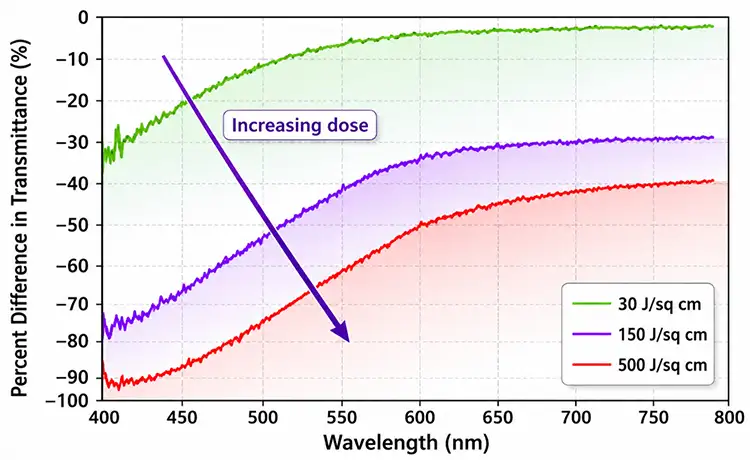
Changes in spectral transmittance and haze were evaluated to determine whether UV-C exposure altered the material’s ability to transmit visible light. Most materials demonstrated minimal changes in optical transmission even at the highest exposure levels. However, PVC again emerged as the most susceptible material, exhibiting measurable increases in haze and reductions in transparency as exposure dose increased (Figure 4).
It was observed that these effects appeared to be concentrated near the surface, suggesting that degradation products may partially shield deeper material layers from additional UV-C penetration.
The results reinforce the conclusion that UV-C degradation often is a surface-driven phenomenon rather than a bulk material effect.
Does UV-C Affect Fire Safety?
An important question for manufacturers is whether UV-C exposure could influence flammability performance by altering polymer chemistry near the material surface.
To investigate this possibility, exposed materials underwent standardized vertical burn testing. The results were reassuring. For exposure doses up to 500 J/cm², UV-C exposure did not significantly affect flammability classifications for the materials evaluated.
Although one polycarbonate formulation exhibited modest changes in certain flammability metrics, all tested materials maintained acceptable performance levels. The findings suggest that the relatively shallow penetration depth of UV-C limits its ability to affect bulk fire behavior under realistic exposure conditions.
Mechanical Properties Remain Largely Intact
Perhaps the most encouraging finding for product designers is that tensile strength and modulus remained largely unchanged for most materials, even at the highest exposure doses.
Despite visible changes in color, gloss and optical appearance, the majority of materials retained their structural integrity throughout the study. This observation supports the hypothesis that UV-C degradation primarily affects surface layers while leaving bulk mechanical properties relatively unaffected.
For engineers and manufacturers, this distinction is critical. Materials may show visible signs of aging while continuing to perform satisfactorily in service.
Implications for UV-C Product Design
Several practical lessons emerge from this work. First, material selection matters. Different polymers respond very differently to UV-C exposure, even under identical conditions. Second, appearance changes should not automatically be interpreted as structural failure. In many cases, discoloration and surface modifications occurred without significant reductions in mechanical performance. Third, wavelength selection may influence material compatibility. Differences observed among 222 nm, 254 nm and 280 nm sources suggest that material evaluations should be conducted using the specific UV-C technology intended for deployment. Finally, the study demonstrates the value of standardized testing methodologies. Consistent exposure conditions allow manufacturers, designers and end users to compare materials objectively and make informed decisions based on quantitative performance data.
Future Directions
This collaborative effort represents one of the most comprehensive evaluations of UV-C effects on polymeric materials conducted to date. More importantly, it provides a foundation for future ASTM and ISO standardization activities focused on the durability of UV-C materials.
Future work will focus on refining exposure methodologies, understanding degradation mechanisms at the molecular level and identifying strategies to improve UV-C resistance through material formulation and product design.

As UV-C technology continues to expand into healthcare, transportation, commercial and industrial environments, understanding material durability will become increasingly important. Standardized testing methods will help ensure that UV-C systems deliver not only effective disinfection but also long-term reliability, safety and performance.
The success of this project was made possible through close collaboration among manufacturers, testing laboratories, academic institutions and UV technology providers working together through the IUVA Task Force on the Impact of UV-C on Material Degradation (Figure 5).
Acknowledgement
The working group would like to thank the International Ultraviolet Association for its continuous support.
Further Reading
- Horn, N., Paccione, J.D., Poelmans, S., et al. Toward Standardized UV-C Exposure Methods for Polymeric Materials: Coordinated Multi-Laboratory Evaluation and Material Response. Standards, 2026.
- Poster, D.L., Miller, C.C., Martinello, R., et al. Ultraviolet Radiation Technologies and Healthcare Associated Infections: Standards and Metrology Needs. Journal of Research of the National Institute of Standards and Technology.
- Kowalski, W. Ultraviolet Germicidal Irradiation Handbook: UVGI for Air and Surface Disinfection. Springer.
- Bolton, J.R. and Cotton, C.A. The Ultraviolet Disinfection Handbook. American Water Works Association.