

By Tatiana Koutchma, Ph.D., UV4Good
Ultraviolet (UV) disinfection now is a well-established technology in food safety applications. It is widely used for air treatment in HVAC systems, surface decontamination on production lines and foods, packaging and cold storage environments. The interest in UV applications for cold-chain transport has been growing, particularly for fresh produce, high-value and export-sensitive food products.
Despite this progress, UV often still is implemented as a set of independent solutions rather than as an integrated environmental microbial-control strategy. In most food facilities, UV systems are installed as point-of-use interventions – above conveyors, inside ducts or inside enclosed treatment chambers. In transport systems, the use of UV remains limited, often experimental, and rarely integrated into broader food safety programs. This fragmented approach no longer reflects how microbial contamination behaves in real-world food production and distribution environments.
Contamination is a Connected System, not Isolated Events
Microbial contamination in food facilities is dynamic and continuous. Airborne microorganisms do not remain in the air; they settle onto food-contact surfaces, equipment and packaging materials. At the same time, routine operations – such as cleaning, personnel movement and product handling – continuously reintroduce microorganisms into the air via aerosol formation. Processing equipment movement, airflow disturbances and pressure with temperature changes further redistribute contamination between surfaces and air. As a result, contamination should be viewed as a connected system rather than a set of isolated events.
However, UV systems typically still are designed around individual targets – either air or surfaces – but rarely both as an interacting system. This creates a gap between how disinfection technologies are applied and how contamination actually spreads in operational environments. A more effective approach is to treat food production, storage and transportation areas as integrated microbial environments, where air, surfaces and human activity form a single contamination network.
Extending the Same Logic into Transport Systems
The same principle applies beyond the processing facility. Food products move through a complex cold-chain system that includes loading docks, refrigerated trucks, shipping containers, distribution centers and retail storage environments. Each step introduces new environmental conditions that influence microbial survival and transfer. Temperature variation, condensation, repeated door openings and variable airflow patterns all contribute to contamination dynamics. Surfaces inside transport units, including walls, floors, pallets and packaging, can act as temporary reservoirs for microorganisms.
Air exchange during loading and unloading further increases the interaction between airborne and surface contamination. UV interventions in
transport environments still are relatively limited and typically not integrated into continuous food safety strategies. This represents a missed opportunity to extend UV-based control beyond the facility and into the broader food distribution chain.
From Point Disinfection to Preventive Environmental Control
The next step in UV application is not simply improving localized disinfection but changing how UV is positioned within food safety systems. Traditionally, UV light is applied as a corrective tool to reduce microbial load at specific points in time and space. A more advanced approach is to position UV as a preventive environmental control technology. In this model, UV systems are designed not only to reduce contamination after it occurs, but also to continuously suppress microbial buildup and limit cross-contamination potential across air and surface interfaces.
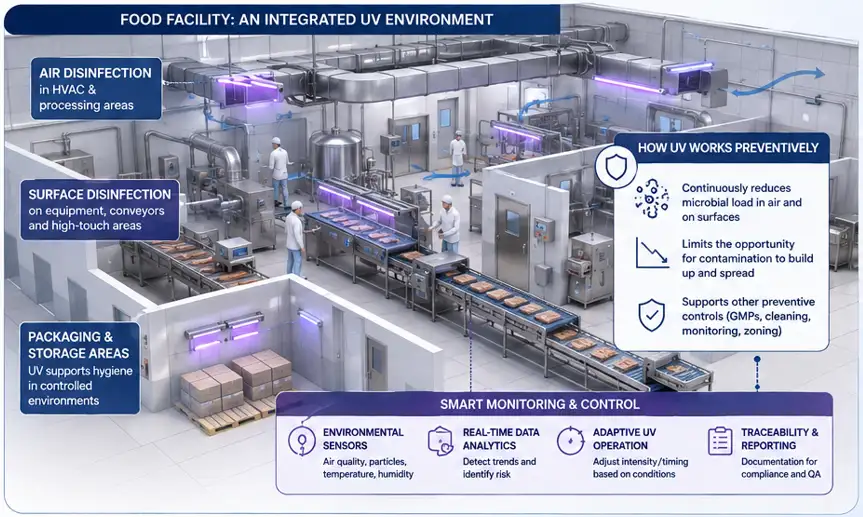
In practice, this means shifting from localized UV application toward strategically distributed systems that maintain a lower baseline microbial load throughout the entire environment. In food facilities and transport systems, contamination is constant rather than an episodic event. Preventive UV strategies aim to reduce this baseline risk, decreasing the likelihood that small contamination events develop into larger food safety issues. This perspective aligns UV more closely with other preventive microbial controls used in the food industry, such as hygienic zoning, sanitation programs and environmental monitoring systems.
Toward Integrated UV Systems Across Facilities and Transport
A system-level approach to UV involves coordinating disinfection strategies across multiple environments rather than treating each location independently. This includes:
- Air disinfection in HVAC and processing zones
- Noncontact and contact surface decontamination in high-risk production areas
- Packaging and storage environments
- Cold-chain transport units
Instead of operating as separate interventions, these elements can be viewed as components of a unified environmental control strategy. The objective is not simply to increase UV usage, but to ensure continuity of microbial control across the entire production and distribution pathway.
Enabling Technologies: Sensors, Automation and UV LEDs
Several technological developments are enabling this shift toward integrated UV systems. UV LED technology has introduced greater flexibility in system design, allowing compact, energy-efficient and application-specific installations. Unlike traditional mercury-based systems, UV LEDs support rapid switching and integration with control systems. At the same time, advances in sensors and monitoring technologies are improving visibility into environmental conditions. Air quality sensors, particle counters and surface monitoring tools now can provide real-time indicators of contamination risk.
When combined with automation and control systems, these technologies enable adaptive UV operation. Instead of fixed-dose disinfection, UV output can be adjusted based on environmental conditions, occupancy patterns or process activity. In transport applications, similar concepts can be applied. UV systems in refrigerated trucks or containers could be triggered by door openings, temperature deviations or predefined sanitation cycles linked to logistics operations. This can move UV from passive technology to an active component of environmental management.
The Role of Far UV-C and Next-Generation Systems
Emerging UV technologies, particularly Far UV-C (around 222 nm), may expand further the potential for continuous environmental disinfection. Far UV-C is being explored for use in occupied environments where traditional UV systems are limited by safety constraints. While still under evaluation, it may enable continuous air and surface disinfection in areas where human activity cannot be separated from UV operation.
UV LEDs also support the development of next-generation systems by enabling modular, distributed and digitally controlled installations. These technologies are not replacements for existing systems but extensions that increase flexibility and integration potential.
Implementation and Validation Considerations
As UV systems become more integrated across facilities and transport environments, validation and safety remain critical. Key considerations include worker exposure limits, material compatibility, system and UV source durability, and energy efficiency. Transport environments introduce additional challenges, such as shaking, temperature variability and system reliability under dynamic conditions.
Standardized validation protocols also are needed to ensure consistent microbial reduction across different environments, accounting for shadowing effects, airflow variability and surface complexity. Importantly, UV should be embedded within broader food safety management systems rather than deployed as a separate intervention.
Conclusion
The future of UV technology in food safety will not be defined by improvements in UV lamp technology or localized disinfection performance. Instead, it will be shaped by integration – across air and surfaces, across facilities and transport systems and, increasingly, across digital monitoring and control platforms.
Reconsidering UV as a preventive environmental control technology provides a pathway toward more resilient and adaptive food safety systems. In this model, the objective not only is to disinfect air or surfaces at specific points, but also to maintain a consistently controlled microbial environment across the entire food production and distribution chain. This shift has the potential to reposition UV from a supporting sanitation tool to a core element of modern food safety infrastructure.