

By Nabiha Ben Sedrine, 1 A. L. Tomás, 2 A. Reichel, 2 P. M. Silva, 2,3 N. C. Santos, 2,3 J. Pinto, 4 I. Calado, 4 I. Silva, 3 V. Machado, 4 P. Abreu, 4 R. Maioto, 5 A. C. Aires, 5 A. Inês, 6 A. Sampaio, 5,7 C. Bouhafs, 1 P. G. Silva 1 and P. Mendes 8
1Castros S. A., Portugal
2Gulbenkian Institute for Molecular Medicine (GIMM), Portugal
2Faculdade de Medicina, Universidade de Lisboa, Portugal
4CeNTI – Centre for Nanotechnology and Smart Materials, Portugal
5Centre for the Research and Technology of Agro-Environmental and Biological Sciences (CITAB, LA Inov4Agro), University of Trás-of-Montes e Alto Douro UTAD, Portugal
6Research Centre-Vila Real (CQ-VR), Department of Biology and Environment, School of Life Sciences and Environment, UTAD, Portugal
7Institute for Innovation, Capacity Building and Sustainability of Agri-Food Production (Inov4Agro), UTAD, Portugal
8MATGLOW, Portugal
Editor’s Note: A peer-reviewed paper is in preparation with collaborators from UTAD. Once the paper is available, a link will be provided from the online version of this article at www.uvsolutionsmag.com.
The COVID-19 pandemic accelerated the adoption of ultraviolet C (UV-C) disinfection technologies worldwide. As organizations sought effective methods to reduce viral transmission in shared environments, UV-C emerged as a powerful non-chemical disinfection technology capable of rapidly inactivating a broad spectrum of microorganisms.
However, the pandemic also revealed an important challenge: successful UV-C implementation requires more than simply installing UV lamps. Effective disinfection depends on understanding microorganisms, surface properties, dose delivery, environmental conditions and system design.
For a multidisciplinary consortium (Castros SA, Matglow, GIMM and CeNTI), the pandemic became the catalyst for a broader innovation journey. What began as scientific research on SARS-CoV-2 inactivation evolved into the development of UV-C disinfection platforms and, ultimately, into sustainable sanitation solutions for the wine industry. This journey demonstrates how knowledge generated during a global health crisis can be translated into practical technologies that improve hygiene, reduce resource consumption and support sustainability goals in food and beverage production.
Understanding UV-C Disinfection Beyond the Laboratory
UV-C radiation, particularly in the germicidal range between 200 and 280 nm, long has been recognized for its ability to inactivate microorganisms by damaging nucleic acids and proteins. This technology is effective against bacteria, viruses, yeasts and molds, making it attractive for applications ranging from healthcare to food processing.
Recent studies have demonstrated the effectiveness of UV-C against food-relevant microorganisms, including Listeria monocytogenes, Escherichia coli, Salmonella spp., Pseudomonas spp. and various spoilage fungi. At the same time, growing environmental concerns have increased interest in UV-C as a sustainable alternative or complement to conventional sanitation approaches. Unlike chemical disinfectants, UV-C leaves no residues, requires no rinsing and can be integrated into automated systems. These characteristics make it particularly attractive to industries seeking to reduce water consumption and chemical use while maintaining high sanitation standards.
Research also has shown that UV-C effectiveness strongly depends on the treated surface. Smooth, reflective, non-porous materials, such as stainless steel and glass, generally achieve higher microbial reductions, whereas porous or rough materials create shadowing effects that reduce irradiation efficiency. These observations later would prove highly relevant to both pandemic-response and industrial-sanitation applications.
Establishing the Scientific Foundation During COVID-19

At the height of the pandemic, the consortium conducted a comprehensive study to evaluate UV-C inactivation of SARS-CoV-2 across a wide range of materials representative of real-world environments. Using a clinical isolate of SARS-CoV-2, the researchers investigated UV-C performance on non-porous surfaces, such as stainless steel, glass, ceramics and plastics, as well as porous materials, including textiles, synthetic leather and upholstery fabrics (Figure 1).
The results demonstrated that SARS-CoV-2 is highly susceptible to UV-C irradiation. For non-porous materials, UV-C doses as low as 8 mJ/cm² achieved viral reduction above 99.9% viral reduction, often within less than one minute of exposure. In several cases, no infectious viral particles were detected after treatment. In contrast, porous materials required substantially higher doses due to shadowing effects and the ability of fibers to shield microorganisms from direct exposure. These findings, summarized in Figure 2, demonstrate that UV-C performance is dependent strongly on surface characteristics.
Perhaps the most important lesson from this work was that successful UV-C implementation requires validated dose delivery. Lamp power alone does not determine disinfection performance: Irradiance, exposure time, geometry and material properties all contribute to the outcome. These observations were consistent with broader findings reported in food industry applications, where surface roughness, reflectivity and material composition are recognized as key determinants of UV-C effectiveness.

From Validation to Technology: The UVtizer Platform
The next challenge was translating laboratory findings into practical disinfection systems. This led to the development of UVtizer, a multifunctional UV-C disinfection platform designed for deployment in schools, offices, transportation systems, hotels and other shared environments. The platform integrated UV-C irradiation with environmental sensing, mobility, safety systems and intelligent operation, transforming scientific knowledge into a deployable technology that delivers validated disinfection performance. More importantly, the platform provided valuable experience in UV-C engineering, including dose management, system safety, scheduled operation and user interaction.
The project demonstrated that effective UV-C systems require a multidisciplinary approach combining microbiology, optics, electronics, software, automation and industrial design. Figure 3 shows the platform, developed during the COVID-19 pandemic as a practical implementation of validated UV-C disinfection principles. The lessons learned ultimately would enable the development of a new generation of industrial sanitation systems.
Extending UV-C Innovation to the Food and Beverage Industry

As the pandemic subsided, attention increasingly shifted toward long-term industrial applications. The food and beverage industry presents unique sanitation challenges. Processing facilities require strict microbiological control while simultaneously pursuing sustainability objectives, such as reduced water consumption, lower chemical usage and improved operational efficiency.
Recent research has demonstrated the effectiveness of UV-C technologies on food-contact surfaces, packaging materials, processing equipment and industrial environments. Studies on stainless steel surfaces, which are extensively used throughout food production facilities, consistently have shown significant microbial reductions when appropriate UV-C doses are applied. These findings suggest that UV-C can be an important component of future sanitation strategies, particularly when integrated with automation technologies. The wine industry provides an excellent example of this opportunity.
Winery Application Development
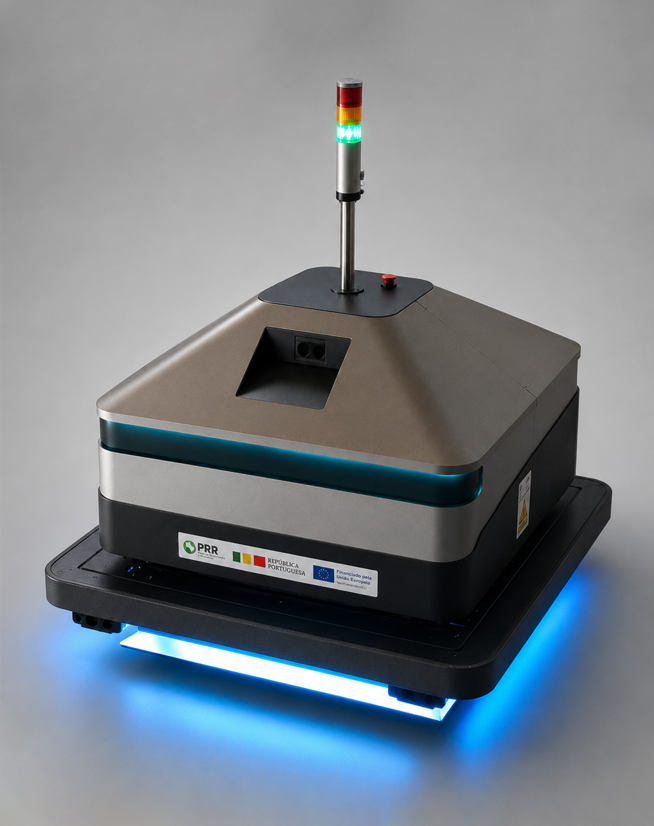
Winery sanitation remains heavily dependent on cleaning and disinfection procedures that consume significant quantities of water, chemicals, labor and operational time. Building upon the scientific knowledge and technological experience generated during the SARS-CoV-2 studies, the consortium (Castros SA and UTAD) developed the Vine&Wine – Answer autonomous UV-C sanitation robot (Figure 4).
Designed specifically for winery environments, the platform combines UV-C disinfection with autonomous navigation and advanced safety systems. The robot incorporates 2D and 3D LiDAR technologies, inertial measurement systems, obstacle detection sensors, collision protection, emergency stop functions, autonomous charging capabilities and a reflective UV-C architecture designed to maximize irradiation efficiency. The robot autonomously can navigate winery facilities and execute repeatable disinfection procedures with minimal human intervention.
Validation in a Portuguese Winery
Technology development is only meaningful when validated under real operational conditions. The platform, therefore, was deployed and evaluated in a commercial winery in Portugal. The results, which will be released in a peer-reviewed publication, showed that UV-C automation can deliver measurable operational and environmental benefits. In addition to efficient microorganism disinfection, compared with conventional sanitation procedures, the robotic UV-C solution achieved water savings of up to 30%. In an industry increasingly focused on sustainability, such reductions represent an important contribution toward responsible resource management.
The validation also showed a 25% reduction in overall disinfection time, simplifying sanitation workflows and reducing operational complexity. Shorter sanitation cycles allow facilities to optimize production schedules while maintaining high hygiene standards.
Beyond these measurable savings, automation offers additional advantages. By reducing operator dependence, the system minimizes human error and ensures consistent, standardized disinfection procedures. Every cycle follows predefined operating parameters, improving consistency, traceability and confidence in sanitation outcomes. These results demonstrate how UV-C technologies can contribute simultaneously to food safety, operational efficiency and environmental sustainability.
Looking Ahead
The development pathway from SARS-CoV-2 research to autonomous winery sanitation illustrates how crisis-driven innovation can create lasting industrial value. Scientific validation studies established the UV-C doses required to inactivate SARS-CoV-2 on real-world surfaces. The UVtizer platform transformed those findings into practical technology. Building on this foundation, the Vine&Wine – Answer project applied the same principles to address sustainability and sanitation challenges in the wine industry. The broader body of research on UV-C applications in the food industry suggests that this evolution is only beginning. As automation, sensing technologies and UV sources continue to advance, autonomous UV-C systems are likely to become increasingly important tools for sustainable food production.
The lessons learned during the pandemic have shown that UV-C is much more than an emergency response technology. When properly engineered and validated, it can be a key component of future sanitation strategies that improve hygiene while reducing environmental impact.
Acknowledgement
The authors would like to thank all the partners for their fruitful collaboration. Financial support is acknowledged: project UVTizer (POCI-01-02B7-FEDER-062110), by Compete 2020, Lisboa 2020, Portugal 2020; co-financed by the European Union. The subproject Answer within Vine&Wine Portugal Project, co-financed by “PRR—Plano de Recuperação e Resiliência, Agendas Mobilizadoras para Inovação Empresarial” and the European Next Generation EU Funds within the scope of the Mobilizing Agendas for Reindustrialization, C644866286-00000011.
Resources:
- A L. Tomas, A. Reichel, P. M. Silva, P. G. Silva, J. Pinto, I. Calado, J. Campos, I. Silva, V. Machado, R. Laranjeira, P. Abreu, P. Mendes, N. Ben Sedrine, N. C. Santos. UV-C irradiation-based inactivation of SARS-CoV-2 in contaminated porous and non-porous surfaces. Journal of Photochemistry and Photobiology B: Biology. 2022;234:112531. https://doi.org/10.1016/j.jphotobiol.2022.112531
- R. Maioto, S. Santos, A. A. Dias, C. Aires, A. Inês, N. Ben Sedrine, P. Mendes, P. Rodrigues, A. Sampaio. UV Radiation: Applications on Surfaces in the Food Industry. Applied Sciences. 2026;16:1877. https://doi.org/10.3390/app160418
- W. Kowalski. Ultraviolet Germicidal Irradiation Handbook. Springer; 2009. https://doi.org/10.1007/978-3-642-01999-9
- T. Koutchma. UV Light in Food Technology: Principles and Applications. CRC Press; ISBN 9781138081420, 2019.
- Guerrero-Beltrán JA, Barbosa-Cánovas GV. Advantages and limitations on processing foods by UV light. Food Science and Technology International. 2004;10:137–147. https://doi.org/10.1177/1082013204044359
- Gómez-López VM, Ragaert P, Debevere J, Devlieghere F. Pulsed light for food decontamination: a review. Trends in Food Science & Technology. 2007;18:464–473. https://doi.org/10.1016/j.tifs.2007.03.010
- UVTizer: https://www.youtube.com/watch?v=0vz28Dhln_s; https://www.i3uvc.com/
Nabiha Ben Sedrine, Ph.D., is a senior R&D scientist and coordinator of international projects at Castros S.A. With a Ph.D. in Physics and 20+ years of R&D experience in academia and industry, her main objective is to develop high-impact innovative solutions for Water-Energy-Food Security in a sustainable way. Dr. Sedrine has technical-scientific skills in various areas of physics, chemistry, optics and agriculture, as well as experience in leadership and innovation projects in academia and industry. She is an active member of the International Ultraviolet Association (IUVA), leading the international Task Force “Impact of UV-C on Material Degradation” and the sub-Task Force “UV light for the benefit of plants: UV-hormesis from the laboratory to the field” part of “UV Solutions for Food and Beverage.” Dr. Sedrine can be reached at nabiha@castros.com.pt.