

By Natalie Wicking, senior brand manager – UV products, Allanson
Commercial and high-traffic environments attract large numbers of people, creating a heightened need to improve indoor air quality. All commercial environments are subject to exposure to tiny particulate matter floating in the air. Invisible in nature, these harmful contaminants often get overlooked. To effectively manage the air purification needs of busy environments, commercial air purification systems are required and are designed to handle large spaces, such as office buildings, retail stores, hospitals, nursing homes, banks and restaurants.

Determining the type of commercial air purifier most suitable for a commercial space depends on a number of factors. A multi-level system, such as one that includes both HEPA filtration and UV-C air purification, will provide a powerful solution for improving the indoor air quality for commercial building occupants.
What are Commercial Air Purifiers?
Commercial air purifiers are devices designed to clean the air in large spaces by using highly efficient filters. They typically are mounted on the wall or ceiling by professionals to keep them out of the way of people and equipment (Figure 1). Advanced devices include additional purification methods, such as UV-C lamps, that go above and beyond the filter alone. These systems that include UV-lamps help to protect people from disease indoors and are referred to as Upper-Room Ultraviolet Germicidal Irradiation (UVGI) by the United States Environmental Protection Agency (EPA).
High Efficiency Particulate Air (HEPA) filters (officially defined by the US Dept. of Energy)are a type of pleated mechanical air filter that are effective at removing ultra-fine particles, such as dust, pollen, mold, toxins and other common allergens often found in the workspace, hospitals and other commercial environments.
HEPA filters are airtight and work to capture particles within a dense mat of randomly arranged fibers through a combination of three physical mechanisms: impaction, interception and diffusion. The result is that cleaner, purified air is returned to the room. The air purifier uses a fan to draw the air into the device, which then is forced through an intricate, maze-like structure of the filter material.
The three mechanisms by which particles are captured are:
- Impaction: Larger particles (such as large dust or pet hair) are heavy and unable to follow the curving airstream around the filter’s fibers due to their inertia. They collide directly with the fibers and become embedded.
- Interception: Medium-sized particles that are small enough to follow the airflow come within one radius of a fiber and stick to it due to weak molecular forces (van der Waals forces).
- Diffusion: Very small, ultrafine particles (such as viruses and smoke particles) move erratically, colliding with gas molecules (a phenomenon known as Brownian motion). This erratic movement increases the likelihood of them hitting and adhering to the filter fibers. This mechanism is most effective for particles below 0.1 microns.

A certified HEPA filter is designed to remove at least 99.97% of all airborne particles that are 0.3 micrometers (µm) in diameter, which is considered the most penetrating particle size (MPPS). Particles that are larger or smaller than this size are actually trapped with even higher efficiency (Figure 2).
Key Factors When Considering an Air Purification Product
When exploring the world of commercial air purification, there are five areas to pay particular attention to that will help set apart the types of systems available in the market.
1. Filtration efficiency. Usually expressed as a percentage (i.e., 99.97%), filter efficiency refers to how effectively an air filter or air purification system can remove airborne particles from the air as it passes through the filter. Simply put, it measures the percentage of particles a filter can capture at a given size (often measured in microns). The higher the filtration efficiency, the more particles the filter can remove. This is a key indicator of how well the system actually can improve indoor air quality. Commercial air purification systems should address three main contaminants that affect indoor air quality:
- Particulate Matter (PM), such as dust, smoke and dirt
- VOCs, such as aerosols and chemicals
- Biological contaminants (BCs), such as bacteria, viruses and mold
2. Clean Air Delivery Rate (CADR). CADR is a key performance metric that explains how much clean, filtered air an air purifier can deliver each minute. It is a measure of speed (how much air the purifier can move through the filters) and effectiveness (how well the system removes particles, such as dust, pollen and smoke). A higher CADR means the purifier can clean more air faster and helps determine whether a specific unit is sized correctly for the room or commercial space in question.
3. Filter Size. In commercial air purifiers, the size of the filter matters as it directly affects performance, airflow, lifespan and overall air quality. Larger filters capture more contaminants since they have more surface area, allowing them to trap more dust, allergens, bacteria and other particles before becoming clogged. In addition, they allow air to pass through more easily. More surface area also translates to a longer filter life, as the filter fills up more slowly, resulting in fewer replacements, more consistent performance and lower operating costs for commercial facilities. Lastly, larger filters provide stable, reliable performance in larger spaces, as commercial environments require high-volume air cleaning.
4. Noise Levels. Workplaces, schools, healthcare spaces and retail environments require quiet operation. A loud purifier can become distracting or irritating, especially with continuous operation. Taking into consideration comfort for its occupants, building and facility operators are tasked with implementing quieter air purification systems. A quieter system helps maintain a calm, productive environment.
- Compliance with noise standards: Many commercial spaces – offices, hospitals, classrooms – have acoustic requirements. A noisy purifier may violate these standards or require relocation to less optimal areas.
- Continuous operation: Purifiers need to run constantly to be effective. If a unit is too loud, people tend to turn it down, turn it off or move it, reducing the actual air-cleaning performance
- Customer and guest experience: Quiet air purification supports a better overall experience
5. Control Flexibilities. These are different ways a system can be monitored, adjusted and managed to meet the needs of a specific space. They make the purifier easier to operate, more efficient and better suited to varying indoor environments. This means being able to easily manage how a commercial air purifier operates (automatically or manually) to get the right performance at the right time. They typically include:
- Multiple speed or airflow settings, allowing adjustability for air cleaning power based on occupancy and pollution levels, as well as time of day.
- Automated or smart controls with features such as auto mode, air quality sensors, filter-life monitoring and scheduled operation.
- Remote control or app-based management allowing facility managers to operate and adjust the unit across multiple rooms or buildings
- Integration with building management systems (BMS)
- Variable operation modes, such as quiet mode, high-power mode, UV-C-only mode and after-hours deep-clean mode
- Safety and lockout features for child safety, tamper-resistant controls or restricted access for maintenance staff
Key Factors to Consider when Choosing a UV Air Purification System
UV air purification systems can be distinguished by several key factors, from technical, design and safety perspectives, that also should be considered when evaluating options.
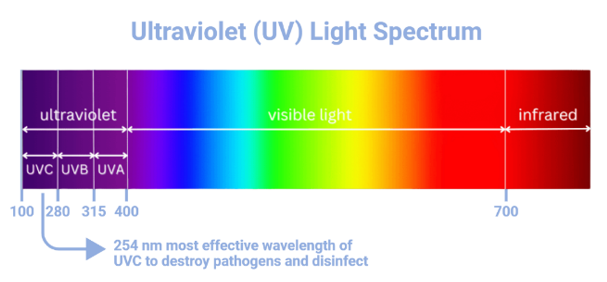
- UV Wavelength. Numerous wavelengths dictate the type of ultraviolet light present, such as UV-A, UV-B or UV-C. The most effective wavelength of UV-C to destroy pathogens and purify indoor air is 254 nm. When considering UV air purification, ensure the bulb emits UV-C light at 254 nm.
- Ozone Emissions. Some germicidal bulbs, typically emitting around 185 nm, chemically react with oxygen in the air to create ozone. Although ozone may be used as a powerful oxidizer to deodorize spaces, it releases harmful lung irritants that are unsafe. Select an ozone-free model.
- Dwell Time. For UV-C to effectively deactivate the molecular structure of micro-organisms, it is critical that the air that needs purification stays near the UV-C lamp long enough for the UV rays to work. Slow fan speeds increase exposure time in standalone systems, and for systems that are installed in conjunction with the building’s existing HVAC, placement on the return side may be more effective.
- Lamp Life. Similar to fluorescent lamps, the effectiveness of UV-C lamps will diminish over time; therefore, it is recommended that the lamps be replaced at specified times. A typical UV-C lamp life is 10 to 12 months. At 12 months, the UV-C lamp will operate at a reduced efficiency of approximately 70% to 80%, which is not ideal for effective air purification and is below the recommended safety threshold. Be aware of replacement requirements for both safety and overhead considerations.
- Placement. Choose between in-duct systems for whole-home HVAC treatment or standalone portable/ceiling units for more centralized and focused purification.
- Safety Considerations. Ensure the UV light is designed with safety in mind. UV-C lamps should be fully enclosed inside the unit to avoid direct contact with eyes and skin, as direct exposure will be harmful.
- Sizing. Not all UV-C lamps are created equally. Consider the wattage of the lamp for the area that requires purification.
- Combined Filtration. In commercial settings, a hybrid system, such as one that includes both a UV-C lamp and HEPA filtration, will provide the highest level of air purification. HEPA filters will capture dust and particles, while the UV-C lamp effects live microorganisms, promoting a healthier environment overall.
Multi-Level Commercial Air Purification
Multi-level commercial air purification systems provide protection against harmful airborne pathogens in commercial spaces, such as hospitals, offices, restaurants, retail spaces, nursing homes and schools. Incorporating additional technologies into commercial air purification systems, such as UV-C, helps maximize the indoor air quality for commercial building occupants.
UV air purification systems use short-wave ultraviolet light (100 to 280 nm) (Figure 3), which works to deactivate the molecular structure of various airborne pathogens, including mold, bacteria, viruses, fungi and allergens. This process, known as ultraviolet germicidal irradiation (UVGI), can be used to decontaminate air, water and surfaces.
HEPA filters alone simply physically capture the particles, and in most cases, smaller microorganisms get past the HEPA filter and recirculate in the air that people breathe. UV-C air purification systems provide an additional layer of protection. Therefore, combining both HEPA and UV-C technologies provides highly effective solutions toward improving indoor air quality (Figure 4).

The Bottom Line
Commercial air purification is an investment that helps improve conditions in schools, businesses and hospital settings by minimizing transmission of airborne microorganisms. When implementing a commercial air purification system, consideration of the key factors listed in this article will help in determining the best suitability for the building needs and, ultimately, achieving the organization’s goals of creating a healthier environment for its visitors.
Natalie Wicking is the senior brand manager for UV products at Allanson. Wicking has 15 years of indoor air quality expertise and a strong passion for educating others. Allanson recently has introduced the AirGuard C600 HEPA plus UV-C Commercial Ceiling Unit, which boasts multi-stage filtration and UV-C chambers that purify indoor air up to 99.99%+. The cost-effective commercial air purifier is designed and engineered for maximum performance and safety. Integrated smart sensing technology allows for efficient and timely replacement of critical components, ensuring continuous operation and air purification. Using a cross-flow fan, AirGuard circulates the air multiple times every hour. Each unit includes two filters (pre-filter and H12 or medical-grade H13 HEPA filter) and a 36W UV-C lamp. It draws in untreated air, passes it through both filters, then through a high UV-C radiation chamber to sterilize the air before releasing the purified air. For more information, email nwicking@allanson.com or visit www.allanson.com.