

By Dr. Richard Mariita, Dr. Tatiana Koutchma, Britt Hafner, Peter Gordon and Dr. Duke Oeba, UV4Good
In an era marked by escalating humanitarian crises, driven by conflicts, natural disasters and climate change, access to safe drinking water remains one of the most pressing challenges. 1 According to the World Health Organization (WHO), 2 over 2 billion people globally lack access to safe and reliable drinking water services, with humanitarian emergencies exacerbating this issue. In conflict zones like Ukraine or disaster-struck regions in Africa, Asia and America, centralized water infrastructure often collapses, leaving communities vulnerable to waterborne diseases such as cholera, dysentery and typhoid. 3 In marginalized rural communities within developing countries such as Kenya, water and sanitation systems often depend on contaminated water sources, 4 which are further compromised by inadequate sanitation and heightened climate vulnerability.
Frequent disease outbreaks, including cholera, 5 and associated mortality in these African communities are directly attributable to waterborne diseases originating from contaminated sources. 6 Traditional purification and disinfection methods, including chlorination and boiling, face limitations in scalability, sustainability and efficacy under such conditions. UV-C LED technology, a compact, mercury-free and energy-efficient solution, is revolutionizing decentralized water purification. 7 UV-C LEDs achieve high inactivation rates of pathogens such as E. coli (4-log or 99.99% reduction) while consuming as little as 0.032-0.053 kWh/m³ of solar power with storage battery-generated energy, 8 overcoming the limitations of mercury lamp-based systems.
This article explores the transformative potential of UV-C LED systems in building resilience during humanitarian crises. It delves into the technology’s mechanisms, advantages over conventional methods, real-world case studies and the role of donation-driven organizations in deploying these innovations where they are needed. By leveraging UV-C LEDs, people can shift from purely underresourced reactive emergency responses to proactive, scalable, impactful strategies that empower local communities through their crisis and into the longer term.

The Humanitarian Water Crisis: A Call for Decentralized Solutions
Humanitarian crises profoundly disrupt water supplies. In war-torn areas, infrastructure damage can contaminate sources with pathogens, while displacement camps often rely on untreated surface water. The most severely affected people are those from marginalized rural communities who lack access to water and face more dangers from climate change. 9 The United Nations estimates that water-related diseases cause 3.4 million deaths annually, with children under five disproportionately affected. Centralized treatment plants, reliant on sporadic service electricity grids and chemical supplies, become impractical in remote or unstable settings.
Decentralized purification, treating water at the point-of-use (POU) or point-of-entry (POE), offers a lifeline. 10 Unlike large-scale systems, decentralized approaches allow for rapid deployment, minimal infrastructure and community-level management. However, methods like chlorination introduce taste issues and potential byproducts such as trihalomethanes, while boiling is a batch process that consumes precious fuel resources. Further, boiling water results in indoor pollution due to the release of polycyclic aromatic hydrocarbons from incomplete combustion. 11 Solar distillation is weather-dependent, and filtration alone may not eliminate viruses.
UV-C LED technology addresses these gaps by providing chemical-free disinfection that targets microbial DNA/RNA, rendering pathogens inert without altering water chemistry. Emitting high-energy, short-wavelength light at wavelengths of 260-280 nm, UV-C LEDs are superior to mercury lamps in humanitarian settings because they are not susceptible to breakage, do not require maintenance, are compact in size, hence enabling the design of unique systems, and offer instant on/off capability. 12 These are all-important field implementable qualities that mercury lamps lack.
Understanding UV-C LED Technology
UV-C LEDs are semiconductor devices that emit ultraviolet light in the C-band (200-280 nm), ideal for germicidal action. 13 Unlike traditional mercury vapor lamps, which use excited mercury to produce UV light, LEDs convert electrical energy directly into photons via electroluminescence. This results in a monochromatic output targeted to peak pathogen inactivation wavelengths, such as 265 nm for maximum DNA absorption.
In water purification systems, UV-C LEDs are integrated into flow-through reactors where water passes over LED arrays. Sensors monitor lifetime, flow rates, UV transmittance (UVT) and dose delivery, allowing for compliance with standards such as NSF/ANSI 55 for microbial reduction. Class A mercury-lamp-based systems must deliver a UV dose of at least 40 mJ/cm2 at the system’s alarm set point to ensure the inactivation of pathogenic bacteria, viruses and cysts. 14 [Note: The UV-C LED industry is still developing standardized testing protocols, and not all UV-C LED systems are certified to this standard.] Advanced systems incorporate IoT for remote monitoring, allowing real-time adjustments in variable conditions.
Key components include the following:
- LED Arrays: Compact modules with a lifetime (LT) of up to 20,000 hours.
- Power Sources: Compatible with solar panels or batteries, enabling off-grid operation.
- Flow Chambers: Quartz sleeves or FDA-accepted reflective materials to maximize fluence (UV dose in mJ/cm²) while not introducing harmful molecules
Compared to low-pressure mercury lamps, UV-C LEDs offer instant on/off functionality, eliminating warm-up times and reducing energy waste. They also are mercury-free, aligning with the Minamata Convention on Mercury, which phases out mercury-based technologies.
Advantages of UV-C LEDs in Humanitarian Contexts
UV-C LEDs excel in decentralized applications due to several core advantages:
- Portability and Scalability: Weighing under 1 kg, LED systems fit in backpacks for rapid deployment and disinfection of water from non-traditional sources. They scale from household units (1-5 LPM) to community systems (up to 50 LPM), ideal for refugee camps or remote villages.
- Energy Efficiency: While individual LED diodes possess a lower electrical-to-optical conversion efficiency than mercury vapor lamps, UV-C LED systems achieve an overall power reduction of 70-90% in field applications. This system-level efficiency applies to the entire treatment apparatus, including battery storage and intermittent duty cycles, leveraging instant on/off functionality to draw power only during active flow, thereby eliminating the continuous energy waste required to maintain mercury lamp temperatures. This optimization enables a compact, solar-powered configuration to easily process over 100 liters of purified water per hour at standard continuous flow rates (such as 1.8 LPM).
- Durability and Low Maintenance: Shock-resistant and mercury-free; LEDs withstand harsh environments without bulb breakage risks. No annual replacements are needed, reducing logistics in crises.
- Environmental and Health Safety: Chemical-free disinfection avoids byproducts and taste alterations. High efficacy against chlorine-resistant pathogens such as Cryptosporidium enhances safety.
- Cost-Effectiveness Over Time: Initial costs (around $200-500 per unit) are offset by longevity and low operational expenses. Levelized cost of water (LCW) can drop to $0.01-0.03 per liter in scaled deployments.
Case Studies: Real-World Deployments
Over the past 30 years, decentralized UV systems have been implemented across continents, with UV-C LEDs gaining prominence since the 2010s. A compilation of 19 case studies by Beck et al. (2025) spans Asia, Africa, Europe, North America and Oceania, covering schools, hospitals and communities.
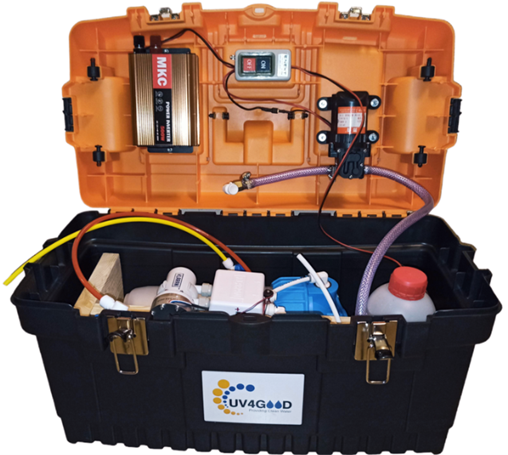
During the Ukraine conflict (2022-ongoing), systems with UV-C LED modules (Figure 1) were deployed in war zones for emergency water treatment. These systems provided portable disinfection, combating contaminated supplies amid infrastructure destruction. 15 Efficacy reached 99.99% against waterborne pathogens, protecting displaced populations against infectious disease.
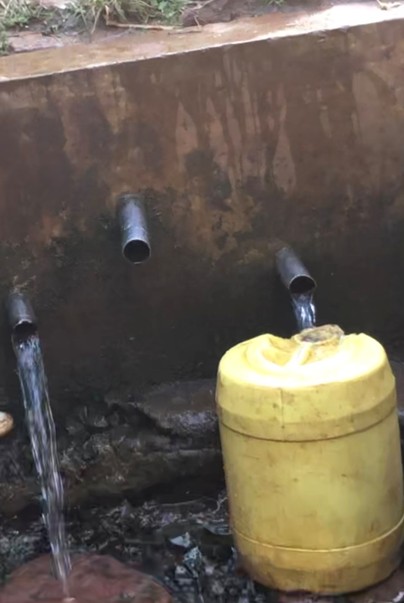
In Kenya, a UV-C LED system treated rainwater for a remote household, achieving >7.5 mJ/cm² fluence at 1.8 LPM, inactivating E. coli and other pathogens. Users preferred it over chlorination due to neutral taste and low power consumption, though cost (up to $200) remains a barrier. 10 The communally shared drinking water sources for local Kenyan villages also were assessed for the installation of UV design solutions (Figure 2).
These cases underscore UV-C LEDs’ utility but highlight the need for affordability and on-the-ground, at the point-of-deployment training.
Challenges and Pathways Forward
Despite advantages, barriers persist, such as high upfront costs, lack of controls, limited availability in low-income regions and gaps in regulatory guidance. Additionally, high turbidity in surface water requires robust pre-treatment; the integration of a specialized coagulant, such as Aquaton, aggregates fine suspended organic and inorganic particles, enabling their capture via mechanical pre-filtration. This multi-stage treatment train dramatically improves UV transmittance (UVT) before the water enters the disinfection core, preventing pathogen shadowing. Technological advances in UV-C LED optical assemblies are quickly addressing these operational gaps.
Long-term sustainability requires close community interaction, alongside ongoing technical training and evaluation, to extract the most operational benefit. Future innovations include optimized pre-treatment and energy sources, multi-wavelength LEDs for broader spectra and multitargeted microbial inactivation, AI-optimized dosing and cost reductions via mass production. Global partnerships, like those under the UN’s Sustainable Development Goal 6, can subsidize deployments. By 2030, UV-C LEDs have the potential to provide safe water for 500 million people in crisis-affected regions.
Conclusion
UV-C LED technology represents a paradigm shift in decentralized water purification by offering resilient, sustainable, scalable and portable solutions. These essential characteristics empower communities to thrive amid adversity and provide a pathway toward local control over precious water resources. As global challenges intensify, investing in UV-C LEDs is not just a technological choice, it’s a humanitarian imperative.
UV4Good is a trusted U.S.-based 501(c)(3) nonprofit organization committed to educating stakeholders in hospitals, schools and food production facilities about Photonic Disinfection best practices, so users fully appreciate, better understand and confidently apply UV technology. The authors are committed to deploying appropriately sized, portable and scalable UV-C LED disinfection solutions in distressed areas. In crisis settings, UV4Good deploys modular UV-C LED kits tailored for off-grid use and varying community needs. Pilot programs already have disinfected thousands of liters of water daily. For more information and to donate, visit https://www.uv4good.org.
Dr. Richard Mariita is a co-founder of UV4Good. Dr. Mariita is a microbiologist, an inventor, author and a specialist in humanitarian UV-C deployment. For more information, email richard@uv4good.org.
Dr. Tatiana Koutchma is the executive director and a co-founder of UV4Good. Dr. Koutchma is the author of eight textbooks and an expert in UV applications for food/water safety. For more information, email tatiana@uv4good.org.
Britt Hafner is the communications and marketing director of UV4Good. Hafnert is a strategist, author and expert in communicating the impact of UV-C technology across industries, with a particular focus on adoption within vulnerable communities. To reach Hafner, email britt@uv4good.org.
Peter Gordon is an advisor to UV4Good. Gordon is an expert in UV-C technology and securing industry partnerships for developing air, surface and water treatment solutions. Gordon can be reached at peter@uv4good.org.
Dr. Duke Oeba is the project manager for Kenya at UV4Good. Dr. Oeba is an author and specialist in electronics and renewable energy solutions for off-grid UV disinfection. Dr. Oeba can be reached at duke@uv4good.org.
References
- Reedy JM, Pousty D, Waliaula BW, Maniga J, Mamane H, Mariita RM. Enhancing quality of life, public health, and economic development in the Global South through waterborne disease prevention with ultraviolet C light-emitting diode technology. Global Health Economics and Sustainability. 2024;2(1):1984. doi:https://doi.org/10.36922/ghes.1984
- UNICEF. 2025. https://data.unicef.org/topic/water-and-sanitation/drinking-water/
- Mekonnen GK, Zako A, Weldegebreal F, et al. Water, sanitation, and hygiene service inequalities and their associated factors among urban slums and rural communities in Eastern Ethiopia. Front Public Health. 2024;12. doi:10.3389/fpubh.2024.1438748
- Osiemo MM, Ogendi GM, M’Erimba C. Microbial Quality of Drinking Water and Prevalence of Water-Related Diseases in Marigat Urban Centre, Kenya. Environ Health Insights. 2019;13:1178630219836988. doi:10.1177/1178630219836988
- Awuor SO, Omwenga EO, Mariita RM, Daud II. Cholera outbreak: antibiofilm activity, profiling of antibiotic-resistant genes and virulence factors of toxigenic Vibrio cholerae isolates reveals concerning traits. Access Microbiol. 2022;4(3):000324. doi:10.1099/acmi.0.000324
- Okesanya OJ, Eshun G, Ukoaka BM, et al. Water, sanitation, and hygiene (WASH) practices in Africa: exploring the effects on public health and sustainable development plans. Trop Med Health. 2024;52:68. doi:10.1186/s41182-024-00614-3
- Crystal IS C. Rethinking uvc led lifetime and reliability in water treatment. Crystal IS. January 20, 2025. Accessed January 19, 2026. https://www.cisuvc.com/rethinking-uvc-led-lifetime-and-reliability-in-water-disinfection-systems/
- Oh Y, Kim HC, Boczek L, Ryu H. Evaluating Disinfection Performance and Energy Efficiency of a Dual-Wavelength UV-LED Flow-Through Device for Point-of-Use Water Treatment. Water. 2025;17(20):2965. doi:10.3390/w17202965
- Chaudhry D. Climate change and health of the urban poor: The role of environmental justice. The Journal of Climate Change and Health. 2024;15:100277. doi:10.1016/j.joclim.2023.100277
- Moore N, Pousty D, Ma D, et al. Decentralized UV disinfection systems in rural areas or low-resource contexts: a case study compilation. Environ Sci: Water Res Technol. 2026;12(1):14-58. doi:10.1039/D4EW00822G
- Shen G, Wang W, Yang Y, et al. Emissions of PAHs from indoor crop residue burning in a typical rural stove: Emission factors, size distributions and gas-particle partitioning. Environ Sci Technol. 2011;45(4):1206-1212. doi:10.1021/es102151w
- Caduff L, Englert A, Meierhofer R, Burkhardt M. Comparison of two different container designs and UV-C LED configurations in their drinking water disinfection efficiency. Front Water. 2025;7. doi:10.3389/frwa.2025.1490541
- Sharma P, Chen P, Han S, et al. Design considerations for a surface disinfection device using ultraviolet-c light-emitting diodes. J Res Natl Inst Stand Technol. 2021;126:126045. doi:10.6028/jres.126.045
- NSF/ANSI 55. Ultraviolet (Uv) water treatment systems, nsf/ansi 55-2024 – ansi blog. The ANSI Blog. December 18, 2024. Accessed January 19, 2026. https://blog.ansi.org/ansi/nsf-ansi-55-2024-ultraviolet-uv-water-treatment/
- Advanced UV for Life. Interview with uv4good – advanced uv for life. 2025. Accessed January 19, 2026. https://www.advanced-uv.de/news/interview-with-uv4good/