

By Liz Stevens, writer, UV Solutions
According to the World Health Organization, one in four people – 2.1 billion people globally – lack access to safely managed drinking water. 1 Despite the best efforts to address the crisis, water disinfection solutions implemented in remote areas around the globe often fail due to high energy demands, complex maintenance requirements, supply chain dependency and high operating costs. To address the continuing clean water crisis, IUVA board member Hadas Mamane leads a group that uses diverse technologies to design, install and support UV LED water disinfection systems.
Professor Hadas Maman was selected as the winner in the Projects/Products: Sustainability category at the 2025 IUVA World Congress for groundbreaking water disinfection work with her non-profit BeyondBlue. Co-founded by Mamane and Dr. Dana Pousty, BeyondBlue operates out of the Water Energy Lab at Tel Aviv University, Israel, delivering water disinfection technologies to underserved and resource-limited communities. Mamane is head of the Environmental Engineering Program at the University and a water disinfection expert with 25 years of leading in academia and underserved regions. Pousty is a UV water disinfection specialist with over a decade of research and engineering experience.
“In applying cutting-edge research findings and expertise to water disinfection needs in the field,” said Mamane, “BeyondBlue offers AI-informed UV LED water disinfection technologies that are affordable and accessible. By leveraging energy-efficient, chemical-free and off-grid compatible solar-powered UV LED systems, BeyondBlue advances sustainable development goals.” Its modular, portable technologies minimize environmental impact while maximizing access to safe drinking water in rural and emergency settings.
Partnerships

BeyondBlue operates under the umbrella of an Israeli non-profit, the Neglected Tropical Diseases Advocacy, Learning and Action Foundation. The foundation collaborates to deploy disease prevention methods, including clean water technologies, to prevent tropical diseases in underserved areas, and during emergencies.
BeyondBlue partners with other humanitarian organizations, supplementing the water infrastructure in target locales. “We work together by integrating UV disinfection into a community’s local operations,” said Mamane. BeyondBlue has collaborated with Innovation: Africa, a non-profit that delivers clean water technologies to remote communities across Sub-Saharan Africa. “We partnered with Innovation: Africa to deploy a UV LED disinfection system integrated into a solar-powered groundwater network in rural Uganda, currently serving 2,000 residents,” Mamane said. BeyondBlue also partners with local organizations, including NGOs, community organizations, water providers, universities, healthcare facilities and system engineers.
Expert Technology Design
While BeyondBlue has a patented UV LED water disinfection technology, it is agnostic about choosing equipment for a project. “The core of BeyondBlue’s work,” Mamane explained, “is UV LED water disinfection technology. Our focus is on implementing practical, field-adapted solutions. Depending on the application, we integrate commercial reactors and systems from industry manufacturers together with our own expertise in disinfection, advanced energy sources, operations monitoring and maintenance technologies and, most importantly, community-based implementation.” UV LED companies actively support these projects by sharing their expertise and dedicating time to help ensure successful outcomes. BeyondBlue bridges the gap between advanced UV LED technology and real-world deployment by adapting systems to challenging field conditions, such as intermittent water and electricity, varying water quality, pressure limitations, maintenance capacity, infrastructure constraints and community needs.
Collaboration on clean water initiatives sometimes is stymied if the umbrella partner organizations only are familiar with chlorine-based disinfection systems and are unaware of the advantages of UV LED technologies. “A common concern raised by NGOs is the lack of residual disinfection in UV systems,” said Mamane, “especially in places where intermittent water supply forces households to store water in tanks or containers.” She cited findings by the People’s Water Data initiative, a library of water quality and household survey data which she co-leads with Professor Pradeep, Indian Institute of Technology Madras. “Interestingly, the survey data showed that residual chlorine often was not detected in household drinking water, even when it was applied at the source,” Mamane said. “This highlights a limitation of relying solely on residual disinfectants due to chlorine demand in infrastructure-compromised systems. These findings reinforced our belief that point-of-use and point-of-entry UV LED disinfection systems can play critical roles in providing safe water where it is most needed.”
One of the organization’s strengths lies in integrating the many aspects of a water disinfection project. These include solar-compatible operation for remote and intermittent-power environments; smart IoT monitoring and remote diagnostics; AI-enabled predictive maintenance and operational insights; and site-specific adaptation according to water quality, hydraulic head budget, infrastructure, energy availability and operational constraints. In addition, BeyondBlue assists with the combination of centralized and point-of-use disinfection strategies; monitoring at critical contamination points throughout the water journey; and community-driven implementation and local maintenance models.
“We plan to adapt UV LED technology for real-world deployment,” said Mamane. “The systems are selected and configured according to field needs, including flow rate, water quality variability, piping constraints, pressure conditions and available solar energy.”
Custom Solutions
Mamane described how BeyondBlue customizes water disinfection solutions. “We adapt commercial UV LED reactors, sensors, monitoring tools and operational strategies according to the realities of each field site,” she said. Examples of customization include selecting the appropriate UV LED reactor according to water flow rate and infrastructure size; adapting piping configurations and hydraulic design based on pressure budget limitations; and adjusting energy consumption and LED operation for solar-powered systems with intermittent electricity. Further customizations include integrating pre-filtration or additional treatment technologies where required; installing point-of-use disinfection at critical points where centralized systems alone cannot guarantee last-mile water safety; configuring IoT monitoring and sensor packages per connectivity availability and operational needs; and tailoring systems to clinics, households, agricultural reuse, emergency response settings or community taps.
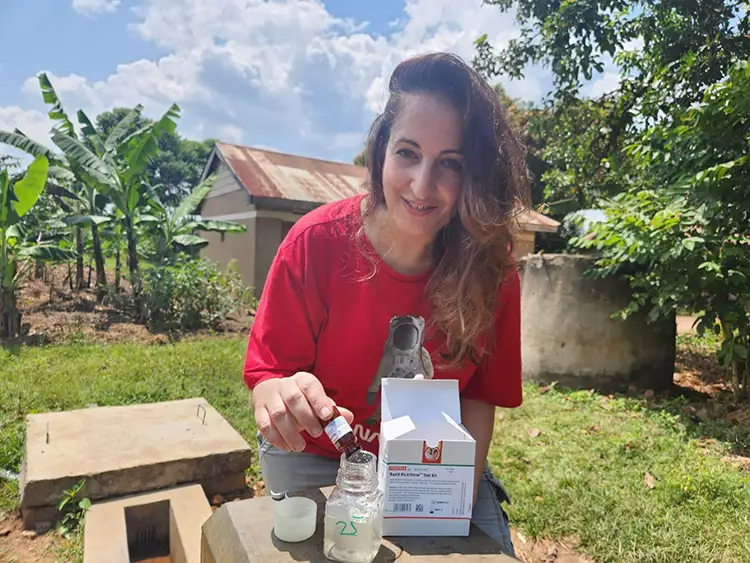
UV LED companies, local engineers, technicians, community organizations, healthcare staff and NGO field teams are involved in the system’s implementation and operation. “During work in Uganda, for example,” said Mamane, “BeyondBlue trained a local engineer who now leads on-site operations. Responsibilities include installing systems, performing maintenance and repairs, collecting water samples and managing the system’s daily operation.”
System implementation includes set-up of IoT data tracking and remote control of technologies. “Using a data-enabled smart network, we build in real-time visibility and control over water quality,” Mamane said. “Our IoT-connected devices don’t just treat water, they provide actionable insights that help communities maintain sustainable, long-term access to clean water.” Insights may include detecting declining UV intensity before disinfection performance drops, identifying abnormal pressure conditions that may indicate flow restrictions, detecting irregular water consumption patterns that may signal leaks or operational problems, identifying unstable solar-energy performance, detecting repeated system restarts or interruptions, and identifying locations in the water distribution chain where contamination risk is highest.
“We plan to combine these operational insights with AI-oriented analytics and remote diagnostics,” Mamane explained, “to improve long-term reliability in locations where technical support is difficult to access.”
BeyondBlue systems are designed to operate in remote and infrastructure-limited environments. In locations without reliable electrical power, solar-powered operations are deployed. In areas with limited or no cellular connectivity, data transmission can be supported through RF (radio frequency) point-to-point links or satellite communication services. “The data-enabled layer is a core part of BeyondBlue’s approach,” Mamane said. “The systems continuously collect operational and water-safety information.” Data collected may include UV intensity and UV dose delivery; UV transmittance and water quality; water and energy consumption; pressure, flow rate and hydraulic behavior; faults, alarms and maintenance events; environmental and energy conditions in solar-powered systems; and precipitation patterns.
The collected information is transmitted to a centralized monitoring platform that creates a “smart network,” a connected infrastructure of decentralized treatment systems operating across multiple clinics, villages, schools or communities. “The purpose is not only to disinfect water, but also to provide continuous visibility into how systems are functioning in real-world field conditions,” said Mamane. The platform enables remote diagnostics and troubleshooting; verification that UV disinfection is operating correctly; predictive maintenance before failure occurs; tracking of water usage and system reliability; data-driven planning for governments, NGOs and water authorities; and AI-powered operational insights and anomaly detection.
BeyondBlue’s approach recognizes that many rural water projects fail not because the technology is ineffective, but because maintenance problems are discovered too late. The monitoring system helps maintain long-term reliability and supports local operators with centralized technical oversight.
Plans, in Development and Long-Term Vision
Work is in the planning stage for collaboration in India with International Centre for Clean Water: Indian Institute of Technology Madras, a global non-profit organization, and LED companies focused on decentralized UV LED disinfection in rural communities. Other work in the planning stage includes emergency water treatment systems for remote and humanitarian settings. BeyondBlue is developing a portable, modular, off-grid emergency water treatment platform designed for humanitarian response, disaster recovery and crisis-affected regions. The organization also plans to expand into decentralized wastewater treatment and agricultural water reuse solutions for off-grid and water-scarce communities.
Mamane stressed the critical need for water disinfection in healthcare centers. “In Sub-Saharan Africa, nearly 60% of healthcare centers lack basic water services,” said Mamane. “Rural clinics in Uganda often depend on unsafe or intermittent water supplies, increasing the spread of waterborne diseases. Unsafe water also increases maternal and neonatal health risks and places a heavy burden on women and girls who spend significant time collecting or treating water.”
BeyondBlue’s long-term vision is to create an intelligent, decentralized water-safety infrastructure that combines commercial UV LED systems, multispectral disinfection science, IoT monitoring, AI-driven analytics and community-based operation. For more information, visit www.beyond-blue.global.
References
- “1 in 4 people globally still lack access to safe drinking water – WHO, UNICEF,” World Health Organization, August 26, 2025, https://www.who.int/news/item/26-08-2025-1-in-4-people-globally-still-lack-access-to-safe-drinking-water—who–unicef.