

By Oliver Lawal, CEO, AquiSense, Inc.
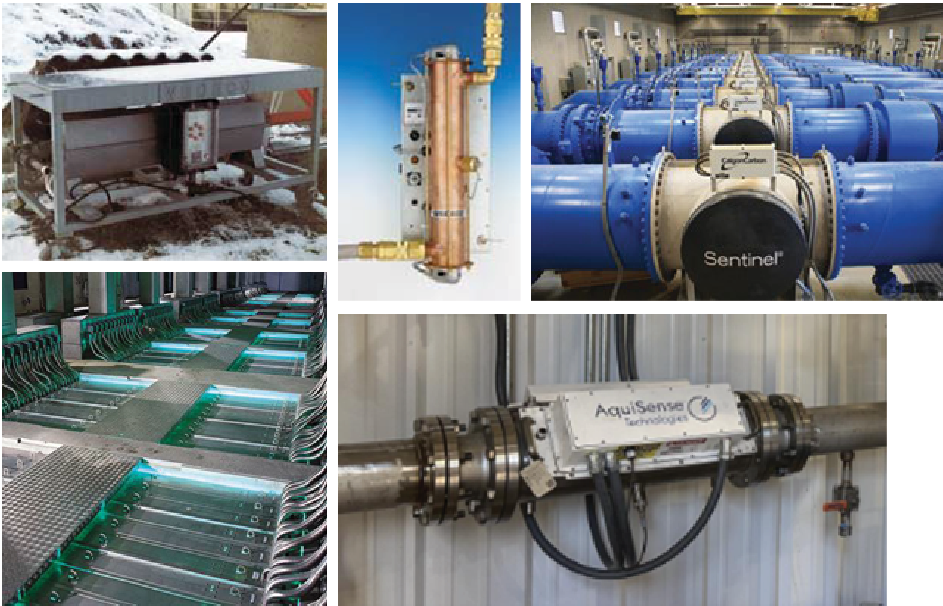
The phrase “It is not the strongest of the species that survive, nor the most intelligent, but the ones most responsive to change,” often is attributed to Charles Darwin, but actually was written by Loen Megginson in his summary of Darwin’s work. Regardless, it’s interesting to draw a parallel – just as different species evolve in response to environmental impacts, UV treatment has changed in response to its ‘environment.’ From the use of natural sunlight in Marseille, France, in the early 1900s, to the first ‘modern’ UV systems using low-pressure lamps in Switzerland and Austria in the 1950s, to the widespread use in North America and Europe by the 1970s (see Figure 1), UV technology has seen increased adoption through its ability to evolve in response to key drivers.
These drivers include the following:
- Improved Technology: The development of effective and reliable UV lamps, drivers and reaction chambers.
- Chemical Use Concerns: Growing concern about the formation of harmful disinfection by-products from chlorine in both drinking water and wastewater.
- Effectiveness: Increasing expectations for high water-quality standards, which have proven highly effective against a range of microorganisms, including bacteria, viruses and protozoa.
- Environmental Awareness:The need for water conservation/reuse due to increasing water scarcity
The evolution, or adaptability, of UV technology has been one of its key strengths and has significant appeal to many practitioners. This evolution is not static. Environmental changes continue to impact the UV industry. Water scarcity and quality concerns are increasing globally due to urbanization, wealth and human expectations. Just as the evolution of species does not occur in a unified monolithic manner, so it is with UV technology. Application needs might differ greatly between Southern California and central Africa; however, the macro trends all are moving in the same direction. Mindful of these drivers, municipalities, corporations and individuals are continuing to evolve their use of UV technology.
UV-C LEDs: An Evolving Species
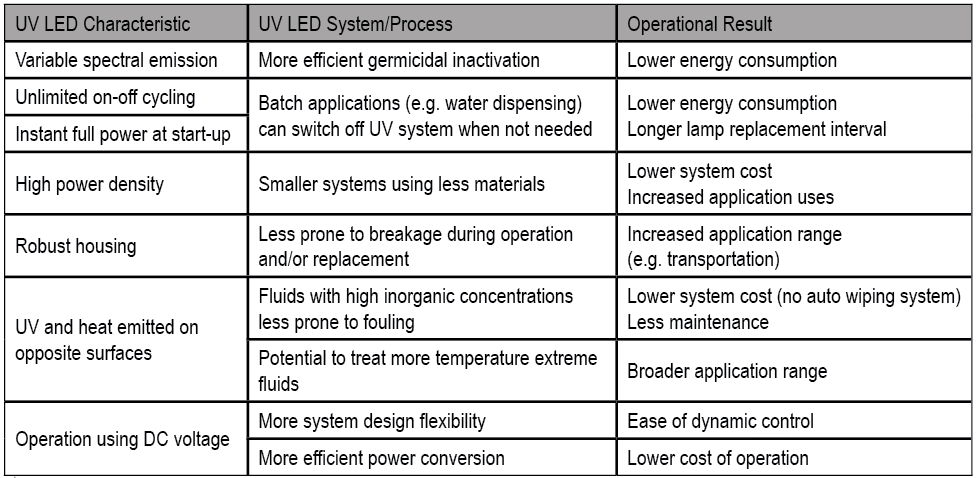
The commercialization of UV-C LEDs has permanently changed the UV industry landscape. The market for small point-of-use UV systems has expanded as manufacturers of beverage dispensers, ice machines, medical devices, grey-water recycling systems, RVs and etc. have realized the operational flexibility gains. Bluetech Research recently labeled decentralized UV LED as a ‘unicorn’ in the water treatment space, and UV Safe, an industry trade group, estimates that over 2 million such systems now are installed. Table 1 highlights characteristics, advantages and operational benefits of UV-C LEDs that are influencing this changing landscape.
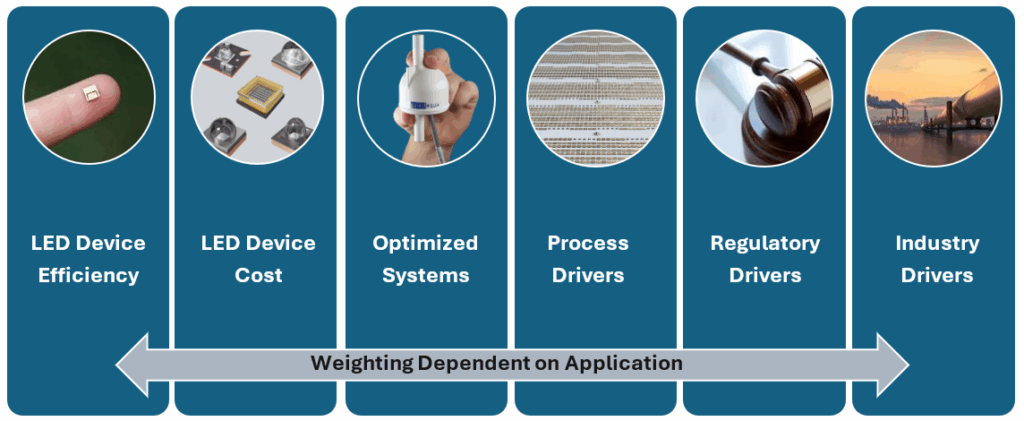
It’s not just small systems that are evolving. UV-C LED system manufacturers are creating certified systems for larger flow applications, providing additional options for municipal, industrial, pharmaceutical and wastewater needs. A valid question is whether these larger UV-C LED-based systems can be produced with more advantageous economic and technical performance levels than traditional mercury lamp systems. Will they show evolutionary fitness or extinction? Just as Darwin identified key factors of evolutionary success, it is possible to identify key factors of technology commercialization success for UV-C LEDs (see Figure 2).
Factors 1 and 2: Lamp Efficiency and Price
The first two factors describe UV-C LED devices, with the most obvious concern being wall-plug efficiency (WPE) – a ratio of input power to UV-C output. At the time of writing, best-in-class UV-C LEDs show a WPE of just over 10%. This often is misrepresented using older, or low-performance, LEDs against a sole comparison parameter of a ~35% WPE low-pressure (LP) mercury lamp, and thus providing justification for discounting UV-C LEDs until such time as they reach that benchmark. This is problematic on several levels.
- First, according to a 2024 Mordor Intelligence report, approximately 49% of the UV market deploys Medium-Pressure (MP) mercury lamps. MP lamps have a WPE of around 15% and, therefore, UV-C LEDs lag by just 5% for a significant portion of the UV market using UV-C LEDs in appropriate applications.
- Second, WPE alone does not account for the germicidal effectiveness bias of different wavelengths. Ishida, et. al., showed photons from an LED with a 265 nm peak are up to 30% more efficient at inactivating microbes than those from a 254 nm LP lamp. 1 This recognizes that achieving a comparable disinfection effect requires fewer photons.
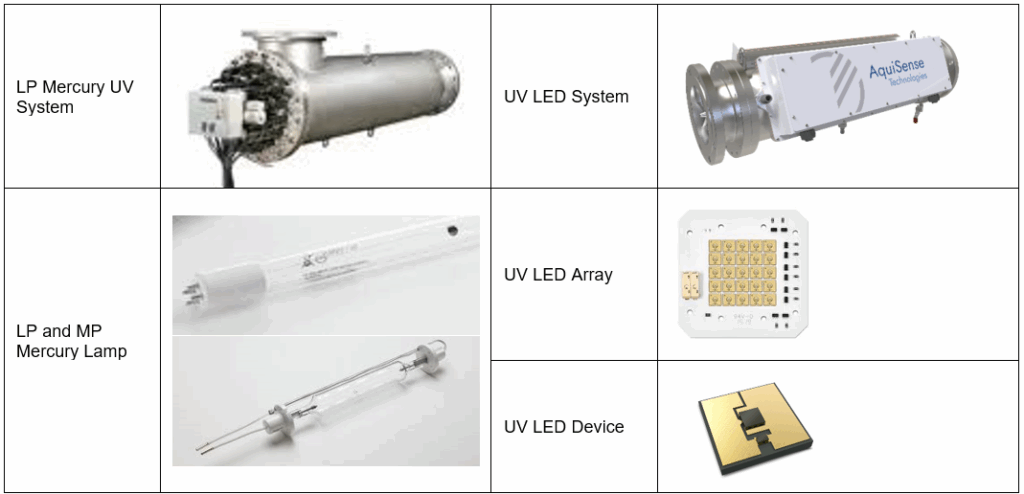
- Third, LED devices are combined into arrays, so comparisons of single devices to any size of mercury lamp draw a false equivalence. Figure 3 shows an appropriate comparison of a mercury UV lamp with a UV-C LED array.
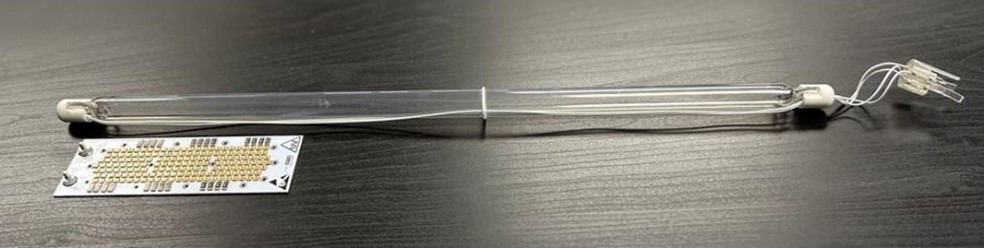
There is no doubt that WPE is a critical characteristic, but discounting power density, lifetime and operational boundaries provides a limited picture. In the example shown in Figure 4, the power density may be calculated as the total UV-C output power divided by the emitting surface/footprint. The UV-C LED array has ~10x the power density of the mercury lamp (0.34 W vs. 0.039 W cm2).
Solid-state semiconductor devices scale into much larger arrays – a mature practice for visible LEDs. Large-scale water treatment systems employing arrays of high-powered UV-C LED lamps already are deployed beyond pilot scale (see Figure 4). UV-C LED arrays are scalable to any size, so there is no maximum capacity that can be achieved when considering replacement of mercury lamps across disinfection systems.

Factors 3 and 4: UV System and Process Design
Understanding the next two factors is helpful because comparing one lamp to another can be misleading, in the same way that a discussion about vehicle efficiency only is meaningful if all contributing factors (such as weight, drag coefficient, transmission, tires, road surface, driving style, etc.) are considered, rather than engine efficiency alone. The efficiency of a UV system depends heavily on reactor design (optical distribution and hydrodynamics), as observed by the wide variety of commercial designs engineered for specific applications. Similarly, process parameters (environmental, duty cycle, temperature, water quality, etc.) have a significant effect on overall efficiency. Ultimately, discussions on the suitability of lamp technology need to take a holistic view.
Consider further MP lamps and follow the WPE argument alone. Would they be commercially used? MP lamps operate 20% less efficiently than LP lamps, with less than half the operating life (5,000 hours). However, they are used because they offer various solutions to a UV system designer, including high power density (small reactor footprint) and polychromatic output (targeted wavelength effectiveness). Consider then the broader view of UV-C LEDs that arrays can have higher power densities and also offer targeted germicidal effectiveness (albeit not necessarily for all the same applications as MP lamps). They also provide over twice the operating lifetime, on/off cycling (batch processes), fast warm-up times, wider process-temperature operating ranges and non-elevated quartz sleeve surface temperatures, which can be a fouling contributor.
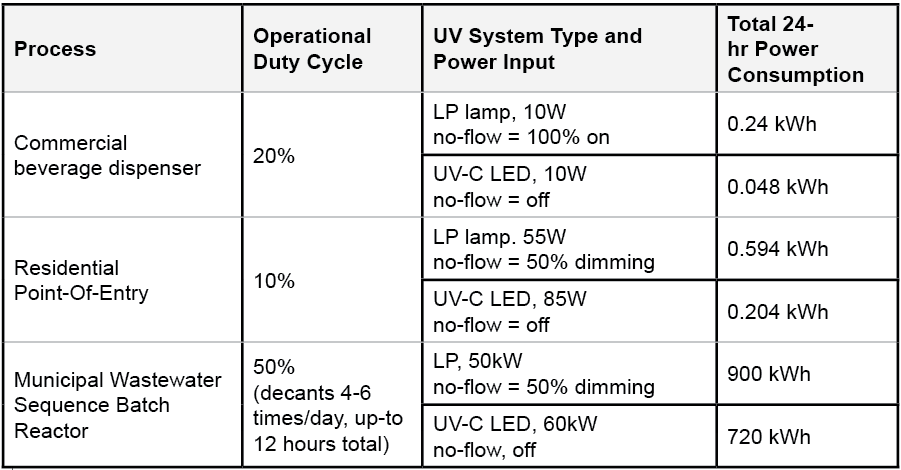
The fact that UV-C LED disinfection systems may be operated in a fundamentally different mode to both LP- and MP-based lamp disinfection systems is a notable prospect for water treatment process designers and operators. Mercury vapor lamps degrade on power cycling and can have relatively long warm-up times; therefore, manufacturers provide usage warranty restrictions and continuous operation is common (with dimming). The result is a system that is operational 24/7, drawing power and degrading lamp output even where the treatment process does not require continuous operation. It’s easy to imagine various batch processes that operate in such a way (see Table 2).
Even continuous processes in larger installations experience latency periods and diurnal cycles, leading to an inefficient mode of operation and the need for additional capital equipment, such as surge tanks. The realization that UV-C LEDs suffer no penalty for power cycling and produce full power near instantaneously is an evolutionary win for UV process designers.
This difference in operation has two key consequences:
- ‘Wall-plug efficiency’ is replaced by ‘operational efficiency.’ Whereas instantaneous efficiency (WPE) offers insight into the underlying technology, it assumes a steady state of operation that is not relevant in many cases. Any comparison of electrical efficiency should take into account the operational mode of the system within a real use case.
- The lamp lifetime/replacement interval converts installed duration to operational duration. Again, the baseline assumption of a UV system is 100% operation, leading to a recommended lamp replacement (e.g., 5,000 or 12,000 hours). By contrast, LED aging is driven by operational hours, so an equivalent 12,000 hours of operation utilized at a 50% duty cycle would result in a lamp replacement interval half as frequent.
This is not to say that every application is suitable for UV-C LED technology, in the same way that not every application is suitable for LP or MP lamp technology. However, it’s clear that another lamp technology is available to solve treatment process challenges. Considering all aspects of a process can help determine which is the best fit.
Factors 5 and 6: Regulatory and Industry Drivers
The final two factors describe external factors related to regulatory and industry drivers. Uncertainty in how mercury regulations will disrupt the existing UV industry can create confusion. The United Nations Minamata Convention on Mercury, a global agreement to protect human health and the environment from human-caused emissions and releases of mercury, entered into force on August 16, 2017. A new mercury mining ban is mandated to be enforced by 2032 to limit supply, and, together with product restrictions, regulators are moving toward a mercury-free environment. A key factor is the Restriction of Hazardous Substances (RoHS) directive, which restricts the use of specific hazardous materials found in electrical and electronic products in the European Union, but which commonly is adopted globally. This controls mercury-added products and manufacturing processes and currently schedules UV-C lamp exemptions to end in February 2027. With cases for both continuing and ending the exemption currently under consideration, this will likely be a driving factor sooner or later.
What about regulatory acceptance of mercury-free alternatives? Certain regulations, like NSF and US EPA, already accommodate the ability to validate/certify UV-C LED technology, and a growing number of products are commercially available within these frameworks. These range from small point-of-use products to full-scale municipal products. Some jurisdictions are on a slower regulatory acceptance path, which inevitably will impact the timing of adoption of new technologies like UV-C LEDs; however, roadmaps are in place.
The reality is that the values and priorities of countries, corporations and individuals also are components changing the UV environment. The pollution at Minamata Bay spurred a global coalition to be stewards of worldwide safety regarding mercury in 2013, with 152 countries currently committed to prioritizing human health and the environment. Concerned corporations are making decisions ahead of regulations to choose mercury-free alternatives, especially those with high-value products, such as pharmaceutical manufacturers.
Final Thoughts and Potential Evolutionary Responses
Predications of a fast extinction event for mercury-vapor lamps similar to that seen with Cathode Ray Tube technology in televisions almost are certainly incorrect. High-flow water treatment products using UV-C LEDs carry a capital expense premium over similar mercury-vapor lamp products, and even when accounting for lower operating costs in some applications, these will not pay back for everyone. Additionally, the product design skill set needed to manage the differences in optical design and thermal management are not widely embedded across the existing UV equipment manufacturing base, so there is a high reliance on a small number of newer manufacturers. Therefore, it’s acknowledged that there still are economic and technical advances to be made.
Similarly, betting against LED technology evolution seems to ignore other industry adoptions, from general lighting to UV curing. The fact is that the UV industry is not monolithic. There are sectors that are driving and adapting to the changing environment. Survival requires managing change responsibly and collectively as regulations and policies enforce pending restrictions. Key stakeholders can be proactive in the evolutionary process. These include the following:
- Regulators can be open to the validation of new technologies and solutions.
- Academia can build a knowledge base on traditional and novel applications using new technologies.
- Manufacturers can innovate, validate and adapt to new technology options and regulations.
- Distributors can share accurate facts about the market readiness of available products.
- Associations can provide a forum for discussion of implications for all shareholders.
“It is not the strongest of the species that survive, nor the most intelligent, but the ones most responsive to change.” This can be applied or ignored, but evolution is a constant that will occur regardless.
Reference
- Ishida, K., Matsubara, M., Nagahashi, M., et al. “Efficacy of ultraviolet-light emitting diodes in bacterial inactivation and DNA damage via sensitivity evaluation using multiple wavelengths and bacterial strains.” Archives of Microbiology 207, no. 1 (April 2025): 130. https://doi.org/10.1007/s00203-025-04324-0.

Oliver Lawal is founder and CEO of AquiSense Technologies, the leading global supplier of UV-C LED water disinfection systems. He has been involved with UV technology since the late 1990s, where he previously served in senior executive positions at Wedeco (Xylem) and Aquionics (Nuvonic); living in UK, Germany, France and New Zealand before moving to the US in 2005. He is a former president of IUVA and currently serves as co-VP Americas. He holds two engineering degrees from Manchester University in the United Kingdom. For more information, email oliver.lawal@aquisense.com or visit www.aquisense.com.