

By Liz Stevens, writer, UV Solutions

SpaceUV Systems, based in Nashik, Maharashtra, India, a 2024 IUVA Americas RadLaunch awardee, has developed a line of upper-air UVGI systems designed to integrate seamlessly with existing HVAC infrastructure. The technology efficiently neutralizes airborne pathogens by rapidly damaging their DNA and RNA. Based on proven upper-room UVGI systems (recommended by US-CDC, ASHRAE and NIOSH), the products are suitable for healthcare environments, academic settings, business offices and other public spaces where additional air purification is needed. The SpaceUV team, with graduates from the Indian Institute of Technology, Bombay, leverages advanced multi-physics non-imaging optical and airflow simulations to optimize the designs. UV Solutions talked with SpaceUV founder and simulation engineer Shreeneet Rathi to understand the core innovations of these new systems.
Addressing Challenges in Air-Quality Management
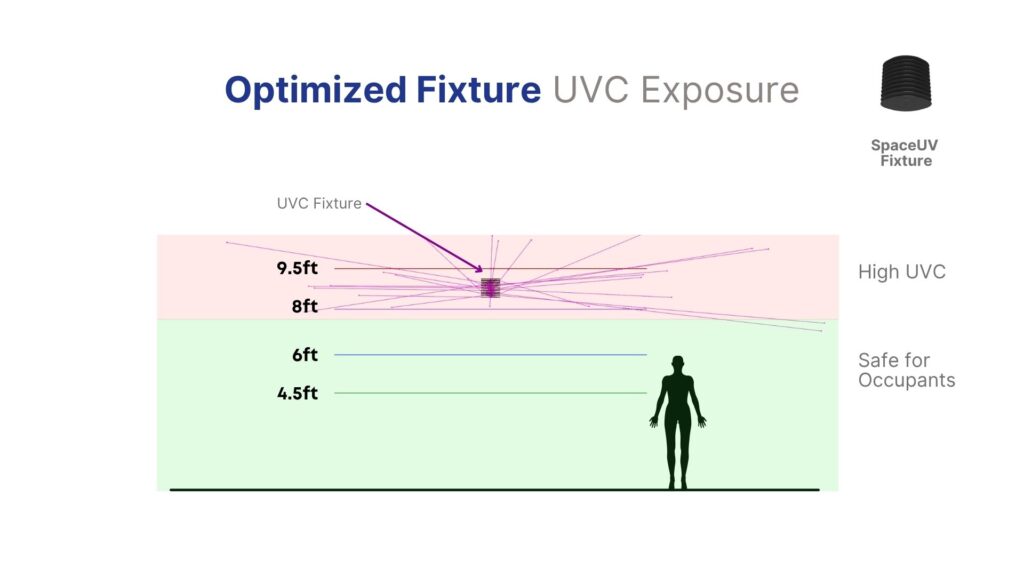
Rathi explained that SpaceUV has designed its upper-air UVGI fixtures to address the challenge of high ambient-dust levels in India and many parts of the world, which particularly is problematic for air-quality management. “India’s ambient particulate levels routinely exceed safe limits,” Rathi said, “with PM₁₀ and PM₂.₅ often driven by road dust, construction and seasonal agricultural burning, among other factors.” The dust rapidly accumulates on traditional UVGI reflectors and lamp surfaces, significantly reducing their germicidal effectiveness within just four to six weeks if not regularly wiped clean. “We re-engineered every horizontal optical-functional surface of traditional upper-air UVGI designs into vertical orientation,” said Rathi. “We also engineered our equipment with highly optimized reflector geometry and fixture designs so that dust cannot affect UV-C exposure by blocking or scattering the UV-C rays. Our vertical optical UV-C fixture design fundamentally resolves the dust accumulation issues.”
Multi-physics ray-trace simulations informed and validated the design changes. “We validated our design approach,” said Rathi, “by tracing billions of photon paths in stochastic non-imaging optical and airflow simulations – both at room level and at fixture level – optimizing different models for different room heights and sizes.” A clear advantage of orienting germicidal optical surfaces along the vertical axis for Indian use cases became apparent. “The result is not only eliminating particulate buildup in the germicidal UV-C light path,” he said, “but a stable germicidal output even under dust concentrations comparable to those inside a flour mill.”
Utilizing Ray-Tracing Simulations
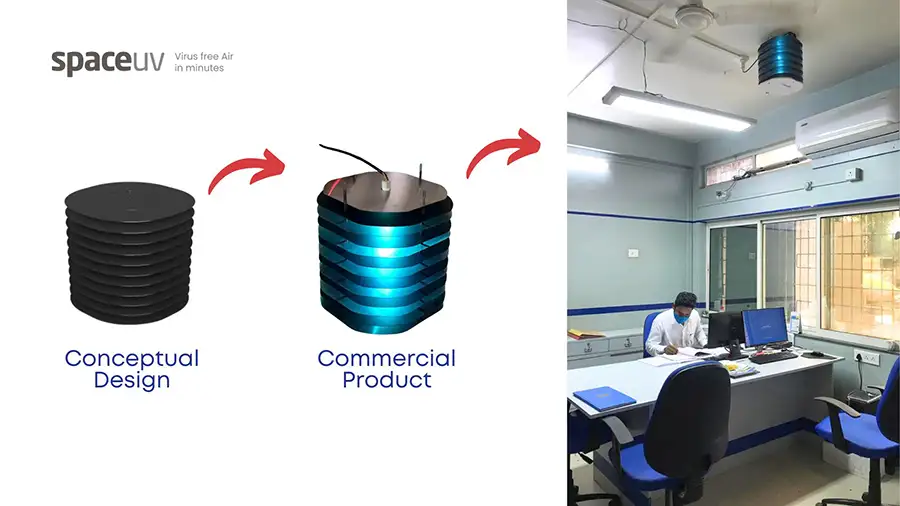
Rathi described the concept of ray-tracing simulations in a little more detail. “Ray-tracing simulation works by modeling light photons and tracking their discrete ‘rays’ that carry power from a source through an optical system,” he said. “Each ray has an origin, a direction and initial intensity; the software then tracks every reflection, absorption or transmission event to predict where energy lands and how much remains.” One of the core elements of ray-tracing simulation is ray sets (lamp models) comprised of pre-measured files containing millions of emitted rays that reproduce the actual angular and spectral emission of UV-C lamps. Other important elements include material BSDFs characterizing surface data that defines how rays scatter, reflect or transmit on a given material (metals, plastics, glass or other custom materials) and CAD geometry, such as 3D reflectors, lenses, baffles and room or fixture models. “This non-imaging ray-tracing approach is the backbone of our design process,” said Rathi, “enabling us to validate and refine every critical optical interface rapidly.” Rathi stated that SpaceUV’s ray-tracing journey has included a series of “aha!” moments. “One of the most prominent discoveries for me,” he said, “was when we realized the extent of the power that we could unlock with non-imaging ray tracing, which was further supported with the help of a sponsorship grant from Solidworks.”
SpaceUV uses low-pressure mercury lamps centered at 254 nm, the germicidal peak for most bacteria and viruses, and actively is experimenting with UV-C LED-based solutions for public transit applications (now in the prototyping stage). Innovative reflective material inside the units maximizes the germicidal UV-C. “Some of our models use diffused reflectors – we use polytetrafluoroethylene (PTFE) through the generous support of Porex,” Rathi said. “There are many benefits of using PTFE over aluminum reflectors in upper-air UVGI use cases. Our simulation set-up measured and modeled the PTFE that we are using to get hyper-realistic irradiance data.”
Current Solutions
The company has a lineup of four products delivering 10 to 24 eACH, i.e., equivalent air changes per hour.
- Ceiling-Mounted Air Disinfector: Ideal for ICUs and waiting areas, this fixture integrates seamlessly into standard grid ceilings, delivering 360-degree UV-C coverage with 180 mm of UV-C volume height
- Wall-Mounted Upper Air Fixture: Specifically designed for corridors and narrow spaces, directing focused UV-C radiation in a slender, controlled zone with up to 210 mm UV-C volume height.
- Split AC Mount Upper Air Fixture: Popular for Indian environments, this unit fits directly onto split ductless AC systems (1-ton, 1.5-ton and 2-ton models), ensuring continuous and high air disinfection in the recirculated air.
- Portable Tower Mount: Developed for hospitality and live-event spaces, these monolithic designs blend into the indoors and offer high portability and ease of use.
Given the dusty environment in India and many other parts of the world, SpaceUV recommends a regular cleaning schedule for the systems. “We advise periodic attention to the fixture for optimal performance and to ensure the overall reliability of the systems,” said Rathi. “Though not mandatorily required for functionality of our upper air UVGI fixtures, we recommend a monthly visual inspection of the lamp surface and the reflectors, and a quarterly wipe-down with isopropyl alcohol of the lamp surface and the reflectors.”
SpaceUV completed its initial pilot in 2022 and now is in production with a certified contract manufacturer with an approximate monthly capacity of 150 units.
For more information, visit www.spaceuv.com.