

By Pratibha Sharma, director of UV business, and Saya Han, director of Marketing and Business Development, Violumas
Transportation systems are among the busiest public spaces, moving millions of people every day. With such high passenger volumes, specifically in large cities, they naturally become hubs for the transmission of communicable diseases. 1 Close contact with a wide range of surfaces, such as handrails, poles, door handles, armrests, seats, touchscreens and ticketing machines, is unavoidable. These high-contact surfaces rarely are disinfected between uses and become ideal environments for microbes to settle and multiply rapidly, especially in hot and humid conditions. 2
Air circulation within buses, trains and airplanes often is designed for efficiency rather than infection control. In many cases, recirculated air inadvertently can spread airborne microbes, increasing the likelihood of cross-transmission among passengers. 3 The risk grows even greater during peak travel, when crowded conditions make physical distancing difficult, or on long-haul flights, where passengers are exposed to the same air for extended periods.
While traditional cleaning methods like manual wiping and chemical sprays are used, they have clear limitations. They rarely are applied in real time and are impractical for large fleets or continuous operations. UV light offers a solution by continuously inactivating pathogens on surfaces and in the air, providing real-time protection while minimizing operational disruption.
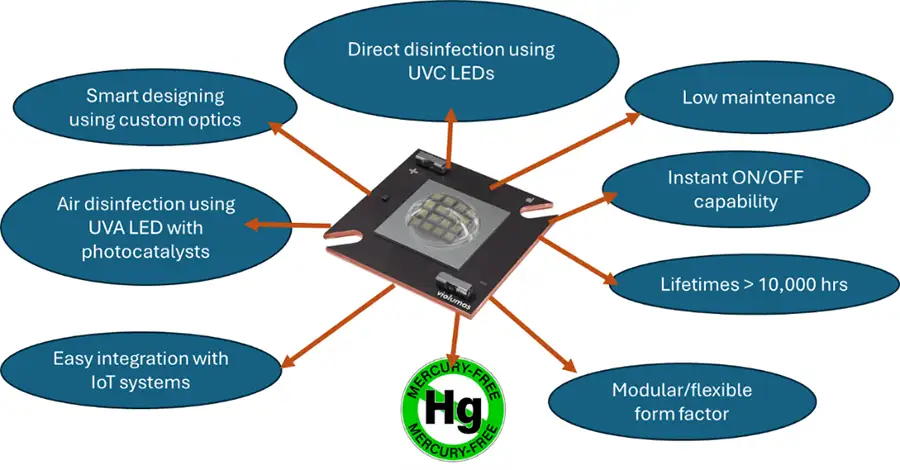
Traditional mercury lamps have been used extensively for all UV needs, but with improvements in efficiency, reductions in pricing and concerns about mercury usage, UV LED use is seeing significant growth in applications that include surface and air disinfection. Deep UV-C LEDs (265-275 nm) are being used successfully for disinfection as they offer a compact, mercury-free alternative with instant ON/OFF capability and no warm-up times (see Figure 1). 4
UV-C light sources increasingly are being integrated into HVAC systems to inactivate airborne pathogens, providing continuous air disinfection in indoor environments. 5 This same approach can be adapted for the HVAC systems of buses, trains and airplanes, helping reduce the risk of microbial transmission through recirculated air. Beyond UV-C, UV-A LEDs can be combined with photocatalyst coatings in air ducts to create advanced oxidation reactions that break down organic contaminants and further improve air hygiene. 6 Such combined strategies allow for both surface and air disinfection, offering a more comprehensive solution to maintain a safer environment for passengers.
This article details potential areas of deployment within transportation systems and the product design considerations that must be assessed.
UV LED Deployment: Potential Locations
UV LEDs can be integrated into different systems in a transport vehicle.
Overhead Stationary Modules
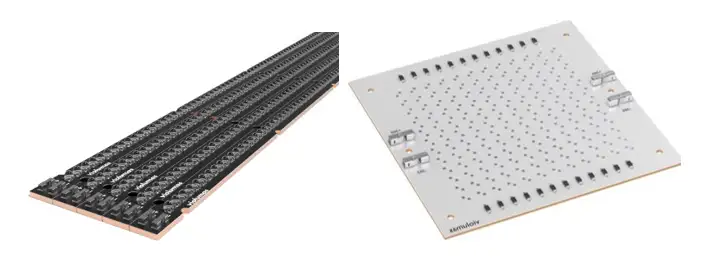
LED luminaires already are being used in transit systems. UV-C LED light bars (see Figure 2a) may be mounted strategically above seats or aisles and target a broad area surface disinfection. 7 These systems mostly are operated after use with no occupancy.
Air Duct/HVAC Integration
Air disinfection systems for transportation can be integrated into air ducts or HVAC units to ensure continuous purification of circulated air. By installing the LEDs within the ducts, the system disinfects air as it flows through, maintaining cleaner cabin environments. Proper design requires consideration of airflow rates and residence time to ensure sufficient exposure for effective microbial inactivation during transport. Linear LED arrays (see Figure 2b) may be needed for such integration. Proper air filters need to be installed to prevent dust accumulation on the LEDs.
Point-of-Use Air Purifiers
Smaller, individual air purifier systems designed for automobiles, such as taxis, rideshares and personal vehicles, offer localized air disinfection and enhanced passenger safety. 8 These compact units can integrate UV-C LEDs to neutralize airborne bacteria and viruses within the vehicle cabin. Typically powered through the vehicle’s electrical system or USB ports, they operate continuously during travel to maintain clean air circulation. Their portable and modular design allows for easy installation, making them well-suited for frequently shared vehicles where air quality and hygiene are critical.
Targeted/Spot Disinfection
UV robots or handheld devices can disinfect specific areas quickly and effectively. UV robots using lamps already are in operation 9 , but with improvements in device efficacies, high-intensity UV-C LEDs may be used to inactivate pathogens on frequently touched surfaces and are valuable especially for rapid turnaround cleaning (no warm-up times).
Product Design Considerations
Modularity of System Components
Transportation fleets (buses, trains, subways, airplanes) vary in size and layout. A modular design allows easy scaling (e.g., adding more LED light bars in a longer bus or using fewer in a small shuttle). A thermal solution also should be developed in a modular format.
Design considerations: UV-C light modules should be standardized and swappable, allowing maintenance teams to replace parts without specialized training. Plug-and-play wiring, integrated optical assemblies and replaceable LED drivers improve serviceability and minimize downtime. Individual LED drivers per module with overvoltage and short-circuit protection would help protect the circuit.
Compatibility with Existing Systems
Retrofitting is more cost-effective than redesigning an entire system. UV disinfection solutions must target integration with current HVAC layouts, lighting grids or seat structures.
Design Considerations: Ensuring electrical and mechanical compatibility is critical to minimizing installation barriers. For HVAC applications, this includes utilizing standard duct-mount brackets and compatible power interfaces. For lighting applications, integration of UV modules alongside standard LED white-light fixtures should be prioritized to streamline deployment. Control systems should be compatible with existing fleet management software and may be implemented via a driver console or a concealed control module, supporting both scheduled and trigger-based operation. Fail-safe operation (“fail as OFF”) should be incorporated to protect users. Optimal thermal management must be integrated within the mechanical constraints to maintain LED performance and longevity.
Homogeneity for Surface Disinfection

UV LED disinfection efficacy depends on achieving the optimal dose across all surfaces (see Figure 3). Hotspots and non-uniform irradiance across a surface would imply a longer exposure time to achieve the same log reduction. Fixture location also can affect the efficiency of UV light, as UV is a line-of-sight technology. In addition, UV-reflective materials can help minimize losses.
Design Considerations: Optics (lenses, reflectors, lightguides) can help ensure uniform irradiance. Modeling tools (e.g., Zemax, LightTools) 10 can aid in optimizing the irradiance distribution over irregular surfaces, such as seats or tray tables. Narrow beam optics 11
can help in reaching longer throw distances.
Effect of UV-C on Materials
UV-C can degrade plastics, fabrics, paints and rubber seals, leading to safety or comfort issues. In transportation, where interior materials must last for years, material compatibility is critical. A study done with materials used in an aircraft 12 shows UV-C disinfection is safe for most aircraft cabin materials in terms of flame retardancy and mechanical strength, even after many years of use. The main risk is aesthetic degradation (yellowing/fading), particularly in light-colored materials.
Design Consideration: Product design must balance the dose for microbial inactivation with acceptable material exposure over the lifetime needed.
Durability and Lifetime
The system must be compatible with the durability and maintenance requirements of a transportation system.
Design Considerations:
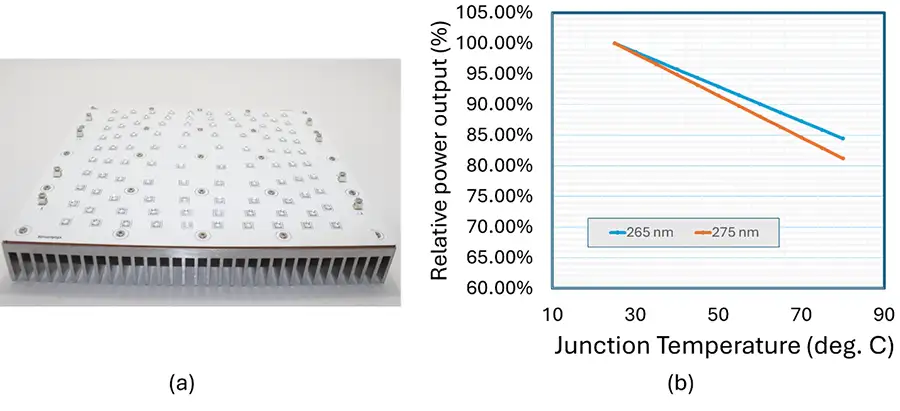
- Thermal Management: UV-C LED output, efficiency and lifetime are influenced heavily by the junction temperature of the LED. Hence, system design must include robust heat sinks and thermal paths to manage this heat. This may be done at the LED package level or at a system level (see Figure 4a, 4b).
- System Lifetime: The selection of LEDs with a long L70 lifetime (operating hours where the light output drops to 70% of the initial value) will aid in maintaining output. Note that the lifetime must be evaluated at the realistic operating current and junction temperature to get an accurate idea of the lifetime.
- Vehicle Vibration and Environment: The final system must be robust and shock-resistant to withstand constant vibration, sudden stops and changes in temperature and humidity common in transit environments.
Dosage Validation
Since LED output decays over time, UV sensors or dosage indicators should be used for validation and recalibration periodically. 13 Product designers must design for LED degradation rates incorporated in the design.
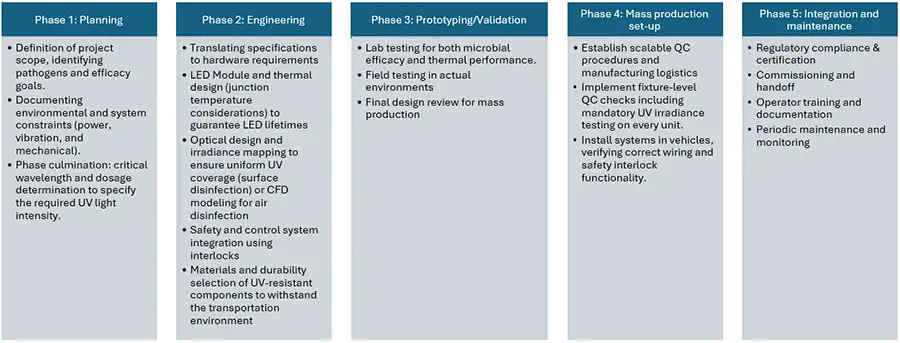
Potential steps from design to deployment can be found in Figure 5.
Future perspective
There is a growing demand for contactless, automated disinfection solutions driven by the need for efficiency, safety and reduced human intervention. UV LEDs offer a sustainable alternative to traditional mercury lamps, providing lower environmental impact, longer operational life and greater design flexibility. Integration with smart IoT systems, such as occupancy sensors, enables automated operation, and adaptive control can help in making transportation systems much safer and hygienic for high use. Effective product design that considers factors such as compatibility with existing systems, optimal dose and the effect of UV-C on surfaces will aid in implementation.
References
- Y. T. Ly, S. Leuko, and R. Moeller, “An overview of the bacterial microbiome of public transportation systems—risks, detection, and countermeasures,” Front. Public Health, vol. 12, Mar. 2024, Art. no. 1367324.
- J. A. Otter and G. L. French, “Bacterial contamination on touch surfaces in the public transport system and in public areas of a hospital in London,” Lett. Appl. Microbiol., vol. 49, no. 6, pp. 803–805, Dec. 2009.
- M. H. Leung, D. Wilkins, E. K. Li, F. K. Kong, and P. K. Lee, “Indoor-air microbiome in an urban subway network: diversity and dynamics,” Appl. Environ. Microbiol., vol. 80, no. 21, pp. 6760–6770, Nov. 2014.
- T. Nicolau, N. G. Filho, J. Padrão, and A. Zille, “A comprehensive analysis of the UV-C LEDs’ applications and decontamination capability,” Materials, vol. 15, no. 7, p. 2854, 2022.
- “Study of UV-C LED technology on in-door air disinfection: An effective mercury-free and ozone-free method to irradicate airborne microorganisms,” in Proc. 5th Int. Symp. Artif. Intell. Med. Sci., 2024.
- N. Bono, F. Ponti, C. Punta, and G. Candiani, “Effect of UV irradiation and TiO2 -photocatalysis on airborne bacteria and viruses: An overview,” Materials, vol. 14, no. 4, p. 1075, 2021.
- K. Vabulnieks, L. Mezule, and A. Patlins, “LED UV-C prototype for disinfection purposes for sustainability of public transport system in unclear epidemiological conditions,” in 2022 IEEE 63rd Int. Sci. Conf. Power Electr. Eng. Riga Tech. Univ. (RTUCON), Riga, Latvia, Oct. 2022, pp. 1–6.
- J. Reissner et al., “Evaluation of the decontamination efficacy of a portable air cleaner using 275-nm UV-C-LED radiation against airborne Coronavirus and Influenza virus,” GMS Hyg. Infect. Control, vol. 20, Aug. 2025, Art. no. Doc44.
- I. Mehta, H.-Y. Hsueh, S. Taghipour, W. Li, and S. Saeedi, “UV Disinfection Robots: A Review,” Robot. Auton. Syst., vol. 161, 2023, Art. no. 104332.
- P. Sharma et al., “Design considerations for a surface disinfection device using ultraviolet-C light-emitting diodes,” J. Res. Natl. Inst. Stand. Technol., vol. 126, Feb. 2022, Art. no. 126045.
- “Viobeam 1×1 Series.” Violumas, California. [Online]. Available: https://violumas.com/products/specialty-optics-viobeam-1×1-series/. [Accessed: Oct. 10, 2025].
- S. F. Yates, G. Isella, E. Rahislic, S. Barbour, and L. Tiznado, “Effects of ultraviolet-C radiation exposure on aircraft cabin materials,” J. Res. Natl. Inst. Stand. Technol., vol. 126, Aug. 2021, 126019.
- J. L. Cadnum et al., “Ultraviolet-C (UV-C) monitoring made simple: Colorimetric indicators to assess delivery of UV-C light by room decontamination devices,” Infect. Control Hosp. Epidemiol., vol. 43, no. 3, pp. 306–311, Mar. 2022.

Dr. Pratibha Sharma is the director of UV Business at Violumas (Cofan Thermal Group), where she leads the development of application-centric UV LED solutions. She holds a MASc from the University of Victoria, Canada, and a PhD from the University of Ottawa, Canada, with research spanning LED lighting and concentrated photovoltaics. Her current focus is on system design while actively exploring novel applications to drive innovation in the field.

Saya Han is the director of Sales and Operations at Violumas (Cofan Thermal Group), overseeing business development and project management for high-power industrial UV applications. A graduate of Northwestern University, she combines technical insight with strategic market development to deliver customized UV LED solutions. An active member of the International Ultraviolet Association (IUVA) since 2018, Saya plays a key role in expanding partnerships and driving innovation in UV LED technology.