

By Dipl.-Ing. Christian Gurrath, engineering manager, Dr.-Ing. Martin Sörensen, CEO and Dipl.-Ing. Frank Zegenhagen, senior R&D manager, Enviolet Corp.
1,4-Dioxane is a synthetic, organic compound recognized as a contaminant of concern in industrial wastewater. It is used as a solvent stabilizer and processing aid in the manufacture of chemicals, polymers, pharmaceuticals and surfactants, resulting in its release to industrial effluents. Due to its physicochemical properties, 1,4-dioxane readily persists in aquatic environments and poses challenges for wastewater treatment and environmental protection. 1 When released into the aquatic environment, it can end up in drinking water and potentially pose a threat to human health. 2
In response, regulatory agencies have established increasingly stringent guideline values for 1,4-dioxane, though standards and compliance requirements vary by jurisdiction. In cases where no regulatory limit values are defined beforehand, Predicted No-Effect Concentrations (PNECs) often are used as target values to be kept at the point of discharge into the environment. For reference:
- In Germany, for water bodies relevant to drinking water, a PNEC value of 5 μg/l applies. 3
- In the United States, no single, nationwide federal PNEC value for 1,4-dioxane in surface waters exists. Individual state-level guidance values exist, e.g., the Final Ambient Water Quality Guidance Values for the State of New York, which include an aquatic life criterion of 18 mg/L and a drinking water criterion of 0.35 μg/L. 4
1,4-Dioxane is highly soluble, exhibits low volatility and has minimal sorption to soils and biomass, allowing it to pass through conventional wastewater treatment processes largely untreated. Biological treatment systems generally are ineffective, leading to their discharge into surface waters. Successful management and degradation of 1,4-dioxane in industrial wastewater typically requires appropriate advanced treatment approaches, such as advanced oxidation processes, as well as source control and enhanced monitoring.
This article outlines the theoretical principles underlying the degradation of 1,4-dioxane by UV-based Advanced Oxidation Processes (AOP). Furthermore, two recent practical examples are presented to demonstrate the real-world application of AOP systems. 5
In the first 1,4-dioxane treatment plant at Europe’s leading chemical producer, a wastewater stream of 8 m³/h (approximately 200 m³/d) containing about 2 g/L of 1,4-dioxane was concentrated to 0.7 m³/h with approximately 20 g/L of 1,4-dioxane using waste steam via vapor-phase distillation.
The resulting stream of approximately 16 m³/d of concentrated dioxane wastewater then was economically treated by oxidation to levels below 5 mg/L and subsequently discharged into the site’s biological wastewater treatment system.
UV-Based AOP Technology – How Does It Work, and What Else Has Been Tried?
Note: In this section, UV-based AOPs utilize RECO technology, developed and applied by the authors’ company. This technology constantly compares UV performance parameters measured at the time with the target values of the lamp, with deviations balanced out by the controller to ensure consistent output.
In UV-based AOPs, degradation of 1,4-dioxane occurs primarily through oxidation by hydroxyl radicals (•OH).
H₂O₂ + hν → 2 •OH
These radicals are the primary oxidizing species responsible for 1,4-dioxane degradation. The reaction mechanisms resulting from the introduction of hydroxyl radicals and the correct process parameters leading to the degradation of 1,4-dioxane are evaluated scientifically and described in great detail by Bolton. 6 In essence, the hydroxyl radicals initiate hydrogen abstraction at carbon sites, followed by oxygen-assisted ring opening and stepwise oxidation to low-molecular-weight intermediates.
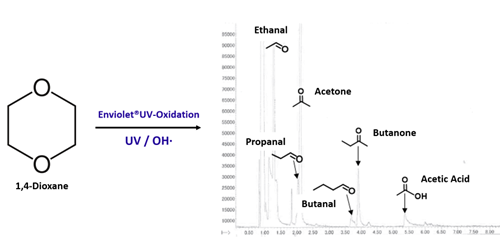
In Figure 1, the resulting low-molecular-weight intermediates are illustrated, as they were detected in wastewater samples treated in the application laboratory of the author’s company.
With sufficient treatment effort and continued hydroxyl radical attack, a complete mineralization of 1,4-dioxane to CO₂ and H₂O by application of UV-based advanced oxidation is possible, in theory. In practice, however, achieving such a degree of mineralization under AOP conditions alone generally is uneconomical.
An optimal approach, therefore, is the combination of an AOP system to degrade 1,4-dioxane, other problematic compounds and recalcitrant fractions of the wastewater COD, followed by a subsequent biological treatment step. This biological stage ideally is suited to further treat the highly biodegradable wastewater produced by the AOP process.
The author’s company develops, tests and optimizes various types of AOP technologies in its application laboratory to provide tailored process and system designs that address the specific treatment requirements of each individual wastewater matrix. Depending on the composition and properties of a given 1,4-dioxane wastewater, a dedicated treatment recipe is developed to steer the reaction kinetics toward a high degradation rate of the target compounds, suppress unwanted side reactions and optimize the economic efficiency of the overall treatment process.
Other treatment methods commonly applied for the removal of micropollutants, such as activated carbon adsorption and ozonation, have been shown to be ineffective and/or inefficient for the degradation of 1,4-dioxane in industrial wastewater. 7
An alternative approach that has been implemented in the past is separation via distillation. 7 However, this method merely transfers the contaminant to a concentrated distillate stream, which subsequently requires disposal – for example, by incineration (thermal oxidation) – which is expensive and generates high amounts of carbon dioxide. In contrast, in-situ oxidative degradation using a UV-based AOP directly degrades 1,4-dioxane within the wastewater matrix. Compared to distillation followed by incineration, this approach generally offers significant advantages in terms of economics, sustainability and overall CO₂ impact.
Case 1: Pulcra Chemicals GmbH, Gerstried
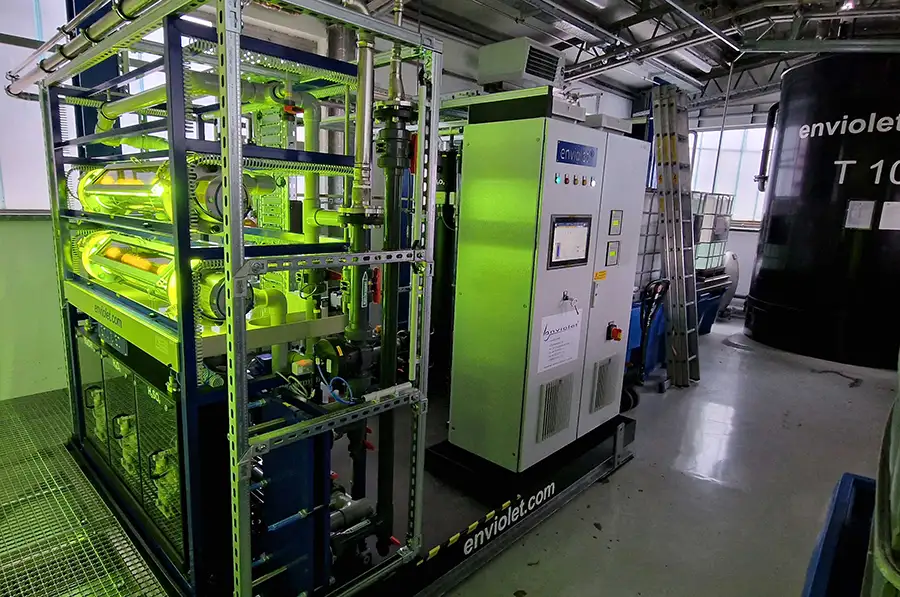
The AOP system in this case was implemented as a skid-mounted unit for indoor installation at Pulcra Chemicals GmbH, a German manufacturer of specialty chemicalsfor the fiber, textile and leather industries (Figure 2).
The 1,4-dioxane-containing wastewater at Pulcra Chemicals was highly concentrated and previously had been sent for external treatment. The newly installed UV oxidation plant now enables the site to treat this wastewater independently, at significantly lower operating costs and with a substantially improved CO₂ balance. Incineration – previously required for disposal and associated with considerable CO₂ emissions – no longer is necessary. Moreover, the CO₂ emissions from the UV oxidation process itself are lower than those previously generated by transporting the wastewater by truck to the incineration facility.
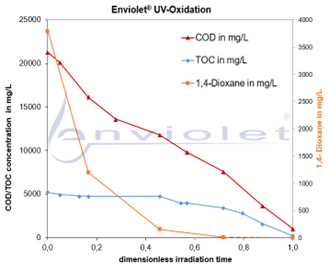
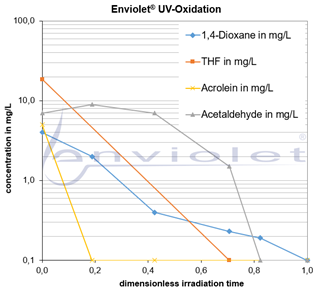
The monitored treatment parameters presented in Figure 3 follow well-established degradation behavior. 8 The results demonstrate that even highly contaminated wastewater can be treated successfully, although this generally is associated with higher treatment costs compared to the majority of standard applications.
Case 2: Manufacturer of High-Performance Materials in the Chemical Industry
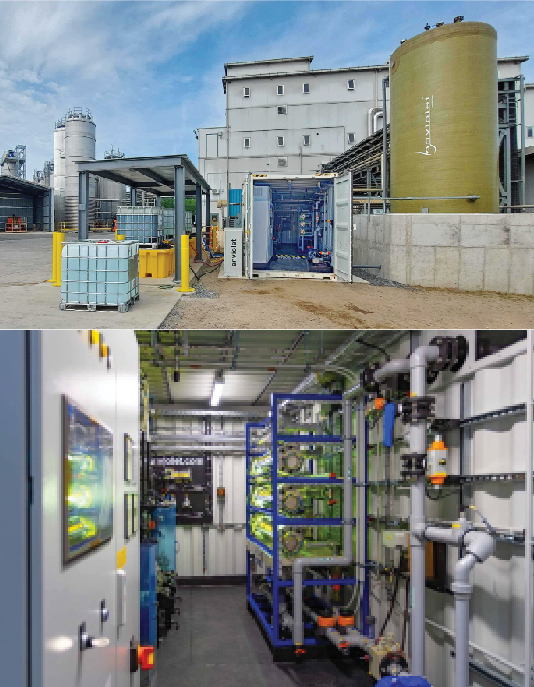
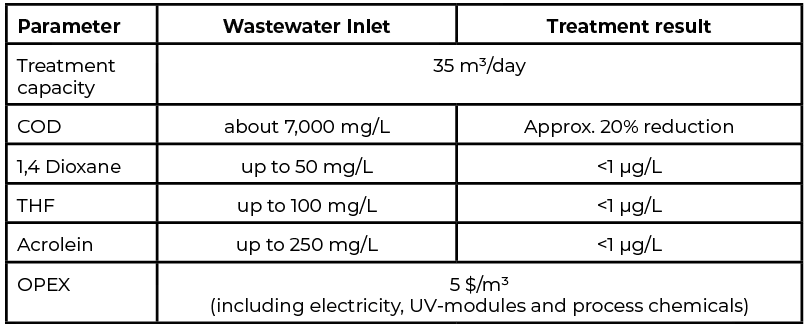
The containerized AOP system depicted in Figure 4 was designed for outdoor placement in a 20-foot shipping container in New Jersey, at a US manufacturer of high-performance materials in the chemical industry. The UV-oxidation unit can treat a maximum of about 35 m³/d of heavily contaminated evaporator distillate containing a number of problematic compounds, such as 1,4-dioxane, Acrolein and THF (Tetrahydrofuran). The applied treatment procedure is able to effectively degrade all recalcitrant contaminants to concentrations below the requirements of <1 µg/L per substance, as outlined in Figure 5 and Table 2, and achieve a biodegradable wastewater for discharge into the public sewer.
Conclusion
UV-based advanced oxidation is an effective and sustainable solution for the treatment of 1,4-dioxane in industrial wastewater. By generating hydroxyl radicals capable of cleaving to the chemically stable dioxane ring, the process achieves high removal efficiencies under practical operating conditions and addresses a key limitation of conventional treatment technologies.
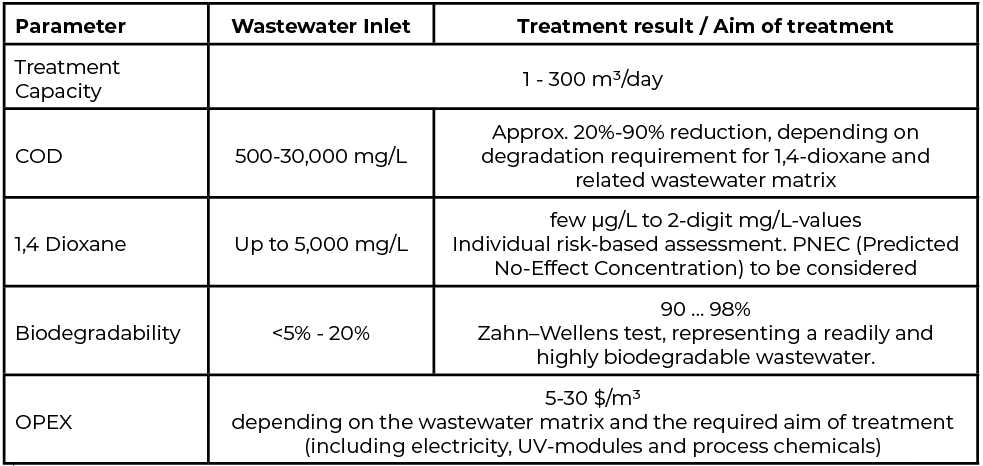
The treatment targets for 1,4-dioxane degradation in systems by the authors’ company are established on a case-by-case basis, considering the requirements of each wastewater matrix, the applicable discharge requirements and a site-specific risk assessment. The results of such considerations can range between a few µg/L to 2-digit mg/L-values depending on what is necessary to achieve below PNEC level values at the end of the treatment chain, when the water is released, e.g., into surface water bodies, especially if these are relevant for drinking water supply.
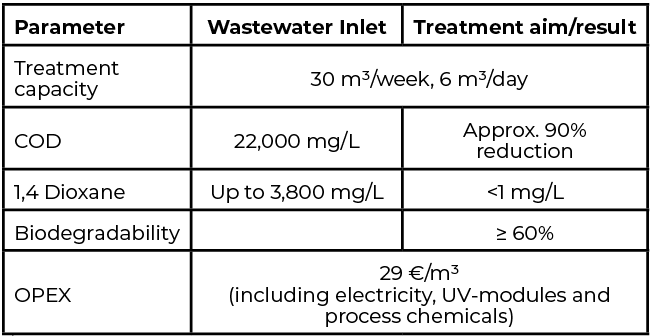
An overview of the range of treatment parameters of successfully implemented projects is summarized in Table 3.
In addition to direct contaminant destruction, the treatment transforms persistent organic compounds into lower-molecular-weight, more biodegradable intermediates, thereby increasing the overall biodegradability of the wastewater. This enhancement supports downstream biological treatment processes, reduces residual toxicity and contributes to more efficient resource use. Collectively, these outcomes demonstrate that the technology desceibed by the authors not only ensures regulatory compliance but also aligns with sustainability objectives by improving treatment effectiveness, enabling process integration and supporting environmentally responsible wastewater management.
Christian Gurrath is a chemical engineer and engineering manager at Enviolet GmbH in Karlsruhe, Germany, with over 10 years of experience in UV-based AOP (Advanced Oxidation Processes) for wastewater treatment, UV-disinfection and photochemical synthesis. His focus is on wastewater treatment projects in the pharmaceutical and chemical industries.
Over 30 years of practical experience in UV-oxidation of industrial wastewater at Enviolet has led to more than 80 treatment systems put into operation for 1,4-dioxane wastewater and has shown that UV-based advanced oxidation, as realized by Enviolet technology, is an effective and sustainable solution for the treatment of 1,4-dioxane in industrial wastewater. For more information, visit www.enviolet.com.
References:
- Stepien, D. K., and W. Püttmann. 2014. Fate of 1,4-Dioxane in the Aquatic Environment: From Sewage to Drinking Water. Water Research, Vol. 48, pp. 406–419.
- Hale, S. E., H. P. H. Arp, I. Schliebner, and M. Neumann. 2020. Persistent, Mobile and Toxic (PMT) and Very Persistent and Very Mobile (vPvM) Substances Pose an Equivalent Level of Concern to Persistent, Bioaccumulative and Toxic (PBT) and Very Persistent and Very Bioaccumulative (vPvB) Substances Under REACH. Environmental Sciences Europe, Vol. 32, Article 155.
- Landesamt für Natur, Umwelt und Verbraucherschutz Nordrhein-Westfalen (LANUV). 2019. ECHO-Stoffbericht – 1,4-Dioxan.
- New York State Department of Environmental Conservation. 2023. DEC Releases Final Ambient Water Quality Guidance Values for PFOA, PFOS, and 1,4-Dioxane. March 15. Retrieved from https://dec.ny.gov/news/press-releases/2023/3/dec-releases-final-ambient-water-quality-guidance-values-for-pfoa-pfos-and-14-dioxane.
- Weckenmann and Sörensen. 2006. How to Dispose of 1,4-Dioxan. PROCESS Worldwide / Plant Apparatus & Engineering, April.
- Bolton, M. I. 1998. Mechanism of the Degradation of 1,4-Dioxane in Dilute Aqueous Solution Using the UV/Hydrogen Peroxide Process. Environmental Science & Technology, Vol. 32, pp. 1588–1595.
- Rüdel, H., W. Körner, T. Letzel, M. Neumann, and K. Nödler. 2020. Persistent, Mobile and Toxic Substances in the Environment: A Spotlight on Current Research and Regulatory Activities. Environmental Sciences Europe, Vol. 32, No. 1.
- Sörensen, M. 2015. Wastewater Treatment by Advanced Oxidation. Pharmaceutische Industrie, Vol. 77, No. 4, pp. 594–607.