

By Steve McDermid, regulatory manager, Trojan Technologies
Groundwater is a critical source of drinking water worldwide, supporting billions of people and serving as a primary supply for many communities. However, decades of industrial activity and agricultural practices have led to the migration of contaminants through aquifers, affecting water quality in many regions. In the United States, more than one-third of the population relies on groundwater for drinking water. 1 Contaminants have infiltrated the water table and affected numerous drinking water sources, making groundwater remediation essential to ensuring safe, sustainable drinking water supplies for the millions of Americans who depend on it.
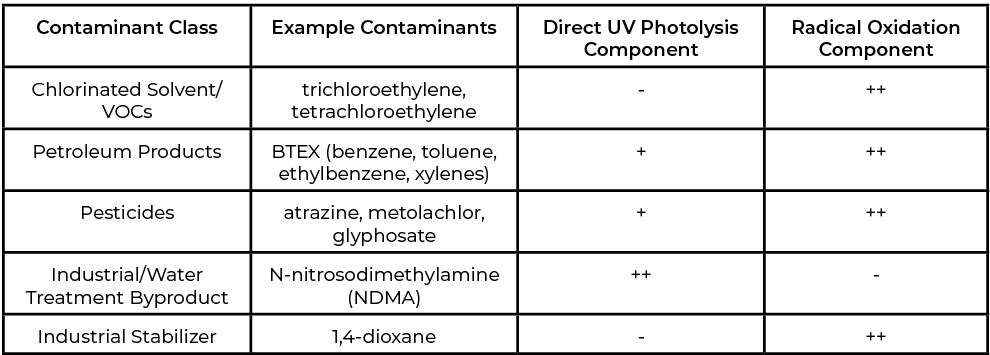
The ultraviolet (UV) light advanced oxidation process (AOP) is an effective option for treating a wide range of organic contaminants in groundwater. Table 1 provides an overview of the relative UV AOP treatability components for various common groundwater contaminant classes. Some are treated by UV only (through direct photolysis), some by UV AOP (through oxidation by radicals generated by UV) and some through a combination of both mechanisms.
How UV AOP Works
UV AOP, combined with an oxidant such as hydrogen peroxide (H2O2), is a treatment process that destroys contaminants in water through a combination of photochemical and oxidative reactions.
- UV light activation
UV light, typically at 254 nm, is applied to water containing an oxidant such as hydrogen peroxide (H₂O₂). - Hydrogen peroxide photolysis (radical generation)
The UV light breaks down a hydrogen peroxide molecule into two hydroxyl radicals (•OH):
H2O2 + UV ————> 2 •OH - Radical-driven oxidation
The hydroxyl radicals generated are highly reactive and non-selective, rapidly reacting with organic contaminants to break them down into smaller intermediates. - Direct UV photolysis of contaminants
Some organic contaminants can absorb UV light directly, leading to breakdown through direct UV light photolysis.
Unlike other treatment processes, UV AOP does not rely on phase transfer. Organic contaminants are destroyed directly within the water phase.
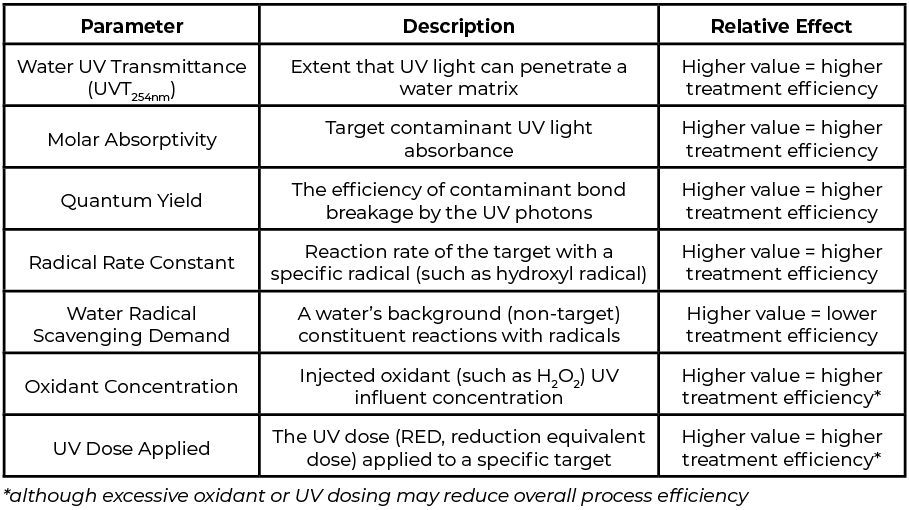
The efficacy of UV AOP treatment depends on several parameters. Table 2 outlines the basics of these parameters, where specific water quality parameters, such as UVT and hydroxyl radical scavenging demand, interplay with system operation (UV and oxidant dose applied) as well as fundamental kinetic parameters to determine the overall treatability of a given contaminant in water.
UV AOP Treatment of 1,4-Dioxane in Groundwater
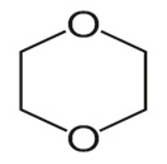
1,4-Dioxane (Figure 1) has been manufactured for decades and still is used as a stabilizer for solvents. It is considered a likely human carcinogen with a 1 in 1,000,000 cancer risk at a concentration of 0.35 ug/L, and it is listed on the latest drinking water Contaminant Candidate List. 2-3 Due to its high water solubility, it is a particular threat to groundwater and, therefore, drinking water. It is difficult to remove through GAC filtration or air-stripping, and even reverse osmosis yields only partial removal. These attributes, along with a favorable hydroxyl radical rate constant, make 1,4-dioxane an ideal and cost-effective target contaminant for UV AOP treatment in groundwater.
For treatment of 1,4-dioxane or any contaminant and across any treatment process, consideration should be made for potential byproducts formation. Since complete mineralization isn’t achieved in a typical treatment process, a good understanding of both the water characteristics and potential byproduct formation is needed (e.g., bromate formation in ozone applications where the water source contains bromide ions).
Regulatory Process for Groundwater Remediation by UV AOP
For nearly two decades, Nassau County in New York has been working to mitigate 1,4-dioxane in groundwater drinking water supplies, as nearly 70% of public groundwater wells had detections above the US EPA MRL of 0.07 ug/L. In 2020, the state set a maximum contaminant limit in drinking water of 1 ug/L, and the current proposed Senate Bill S149 aims to lower that to 0.35 ug/L, although it has not yet been adopted as of this writing.
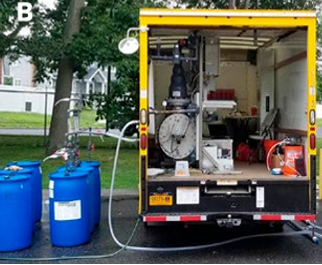
To help mitigate the 1,4-dioxane remediation effort, in the early stages, the author’s company worked closely with consulting engineers, municipalities, contractors and regulators to provide UV AOP solutions. The process involved education on UV AOP technology and initial bench-scale water quality testing of numerous samples. Additionally, UV AOP piloting at multiple sites was conducted to ensure regulators were comfortable with the efficacy of the process (Figure 2). Finally, during and after full-scale UV system commissioning, support was provided through the co-development of a regulator-approved standardized UV AOP system performance test matrix, as well as the interpretation of data and reporting of results to ultimately obtain water use permits. This collaborative approach has resulted in the installation of nearly 100 UV AOP systems at multiple wells throughout New York state, treating over 200 million gallons per day and demonstrating up to nearly three-log reduction (99.9%) of 1,4-dioxane.
Water Quality Considerations
Hydroxyl Radical Scavenging Demand
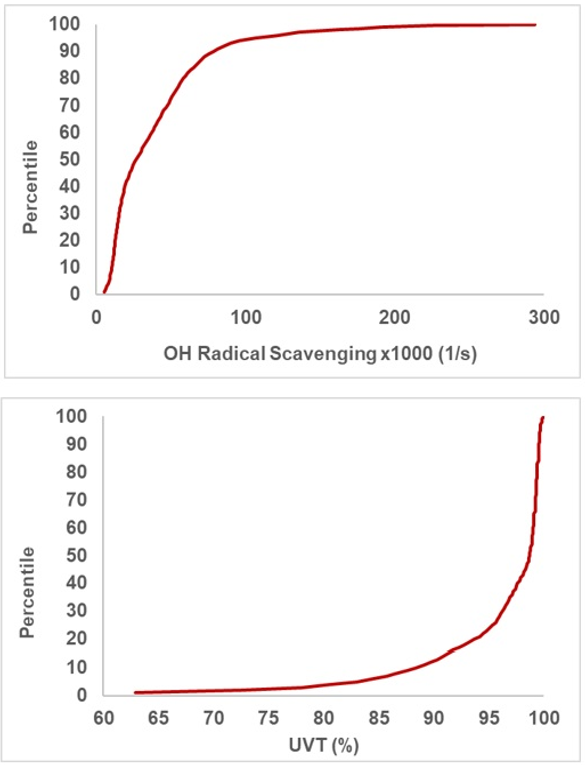
Hydroxyl radical scavenging demand is one of the most influential water quality parameters for UV AOP sizing for water treatment. This parameter is specific to each project site due to the water source and process treatment train. It is measured using a UV-collimated beam test with a probe compound and hydrogen peroxide, where the measured probe degradation rate is inversely correlated to scavenging demand. The author’s company has measured over 3,200 water samples for various parameters, including scavenging. Figure 3 shows the scavenging and UVT results as percentile graphs, with 50% percentile values of approximately 25,000 s-1 and 98%, respectively.
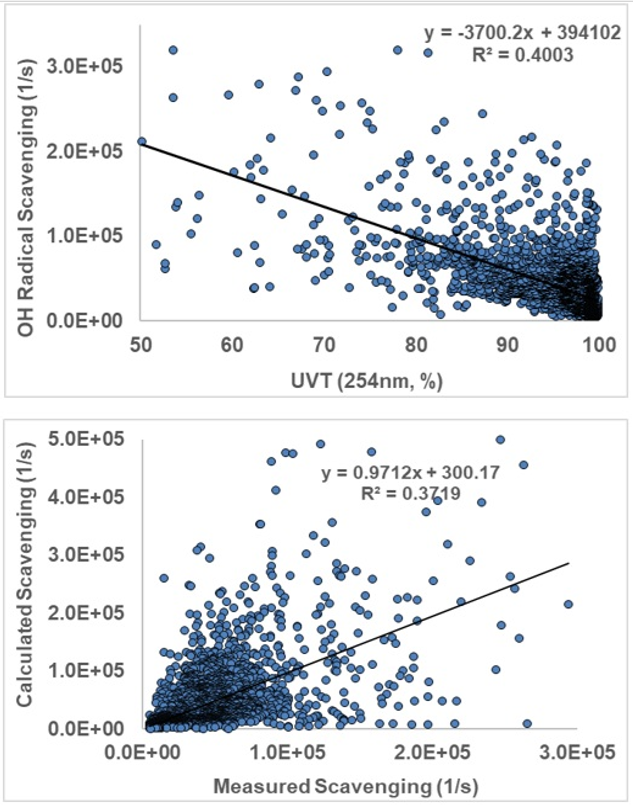
Scavenging is affected by inorganics such as NO2–, CO32-, HCO3–, as well as total organic carbon (TOC). Although it may seem intuitive to assume that high UVT waters will have low scavenging values, this type of estimation is not sufficient for accurate system sizing. Similarly, although correlations with TOC (specifically NOM) with scavenging are available, caution must be taken to avoid inaccurate UV system sizing that is based on these calculations alone. 4 Figure 4 shows the poor correlation between both UVT and TOC-based calculated scavenging and measured scavenging. Therefore, scavenging must be measured on a project-specific basis to ensure accurate UV system sizing.
Nitrates and LP vs. MP Systems
Groundwater often is impacted by significant concentrations of nitrates. The nitrates compete with hydrogen peroxide for UV photons, which decreases the efficiency of the UV AOP process. Additionally, nitrates photolyze to nitrite, which is a strong radical scavenger. This effect is increased significantly when medium-pressure (MP) UV lamps (polychromatic 200-300 nm) are chosen instead of low-pressure (LP) UV lamps (253.7 nm). This is because the lower wavelengths of the MP lamps are further absorbed by the nitrates, thereby forming more nitrite compared to the LP lamps, and this can have a significant effect on UV system sizing. For example, groundwater with 10 mg/L nitrate can require up to 3.5 times more electrical power for an MP system compared to an LP for the same operating conditions. Therefore, care must be taken when choosing UV system lamp technology when nitrates are present.
UV AOP System Components
A complete UV AOP system incorporates a UV chamber, an oxidant storage and dosing system, and, in many cases, an oxidant quenching system for residual oxidant. A control system is used to integrate all components. Part of the control system is the control program, which operates to maintain the treatment objectives. The control program can be designed to operate at fixed “Critical Control” setpoints. These setpoints often involve a combination of power usage and oxidant dose and/or minimum threshold values for operation. They may target a specific log reduction value (e.g., 1 log removal of 1,4-dioxane or NDMA) or even a specific electrical energy per order (EEO, electrical power usage normalized for flow rate and log reduction achieved).
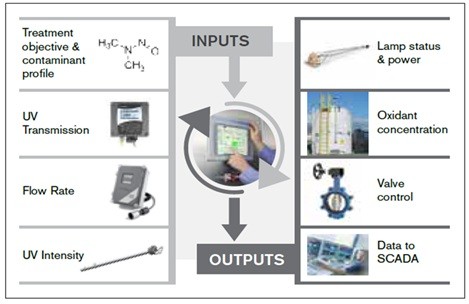
Control systems also can operate with continual inputs, including changing water UVT, flow rate and UV light sensor intensity, with outputs including UV lamps on, lamp power setting and oxidant concentration dosing (Figure 5). Significant cost savings from continual minimization of O&M costs give this “Active Control” approach the advantage over a Critical Setpoint approach. There also potentially is a reduction of harmful byproducts due to the avoidance of overdosing UV light and oxidant. More importantly, public health is better protected using an Active Control approach due to the incorporation of live water quality inputs that could be missed by a Critical Control approach if the setpoints were determined under more optimal water quality relative to what the system is operating to, and especially in the event of a water quality upset upstream of the UV system.
Conclusion
Groundwater remediation is becoming increasingly necessary to meet water consumption needs and maintain high drinking water quality. UV AOP plays a critical role in this effort, as it can reliably treat a wide range of groundwater contaminants. To do this effectively, a good understanding of the treatment mechanisms is required, as well as proper characterization of the water requiring treatment. Using measured rather than calculated hydroxyl radical scavenging demand is crucial for accurate UV AOP system sizing. Selecting the right UV technology, working collaboratively with all stakeholders and employing Active Controls for system operation all ensure successful operations and ultimately, the protection of public health.
References
- U.S. Geological Survey, 2016. Groundwater- the Invisible and Vital Resource. https://www.usgs.gov/news/featured-story/quality-nations-groundwater.
- U.S. Environmental Protection Agency, 2014. Technical Fact Sheet- 1,4-Dioxane. https://semspub.epa.gov/work/01/575107.pdf.
- U.S. Environmental Protection Agency, 2022. Fact Sheet: Fifth Contaminant Candidate List (CCL 5). https://www.epa.gov/system/files/documents/2022-10/Fact%20Sheet%20Final%20Fifth%20Contaminant%20Candidate%20List%20%28CCL%205%29.pdf.
- Westerhoff, P., Aiken, G., Amy, G. & Debroux, J., 1999. Relationships between the structure of natural organic matter and its reactivity towards molecular ozone and hydroxyl radicals. Water Research, 33, pp. 2265-2276.
Steve McDermid is the regulatory manager at Trojan Technologies, a manufacturer of UV and filtration water treatment systems. With over 20 years at Trojan Technologies, McDermid has supported many wastewater and drinking water disinfection projects, as well as UV advanced oxidation remediation and indirect and direct potable reuse applications. McDermid can be reached at 519.457.3400. For more information, visit www.trojanuv.com.