

By Jennifer Brons, research program coordinator, Light and Health Research Center at Mount Sinai; Dr. John D. Bullough, program director, Light and Health Research Center, Icahn School of Medicine at Mount Sinai; and Dr. Mark S. Rea, professor, the Department of Population Health Science and Policy, Icahn School of Medicine at Mount Sinai
Global food production will need to increase to feed a growing population, but plant pathogens are responsible for annual agricultural yield losses of around 20%. 1 Farmers face increasing microscopic and ecological challenges with the use of chemical pesticides. As pathogens become increasingly resistant to bactericides and fungicides, farmers must use new, more expensive chemical formulations every few years. Simultaneously, farmers face increasing regulatory limitations on chemical pesticide use due to their collateral damage to public health and to the environment.
Crop treatments employing UV-C for pathogen control may be a viable addition to the farmer’s arsenal. In recent decades, UV-C applications have been shown to be cost-effective against several pathogens affecting field-grown crops, including strawberries, grapes, apples, beets and cucurbits. 2-9
How UV-C Works
Similar to the use of germicidal UV-C to combat mycobacterium tuberculosis, UV-C radiation damages plant pathogen DNA, preventing reproduction. 10 All biology, however, has a way to repair DNA damage. Plant pathogens have a particular blue-light-activated DNA repair mechanism 11 that makes them more vulnerable to UV-C radiation at night. By irradiating crops with UV-C at night, the pathogen’s blue-light-activated repair mechanism is circumvented. 12
UV-C radiation also can induce secondary effects on cell physiology and function that render them inactive. Given the multi-damaging effects of UV-C radiation, pathogens have difficulty developing resistance, as exemplified by the fact that UV-C radiation remains effective for the germicidal treatment of water, air and surfaces even after nearly a century of use. 13, 14 It should be noted, however, that UV-C irradiation is less effective on melanized pathogens (e.g., downy mildew 9). So, it is conceivable that some plant pathogens could develop greater resistance to UV-C by developing higher melanin densities. Although this has yet to be shown, certain chemistries 15 that limit melanin production could, in theory, be combined with UV-C radiation.
UV-C dose calculations must be adjusted not only by pathogen type but also by crop type. Some crops (e.g., strawberries) are hardy and can withstand relatively high levels of UV-C irradiation. 2 Other crops (e.g., beets) have a lower tolerance, and phytotoxicity becomes problematic for those crops. 7 In addition, the foliage of the crop must be considered. Strawberry foliage is compact and short, making it ideal for UV-C applications, 2 whereas squash foliage is tall and wide, necessitating higher dosages (irradiance × duration) to be effective. Mount Sinai, Cornell University and others currently are conducting research to develop “UV-C prescriptions” for specific crops. 16, 17
UV-C Technologies
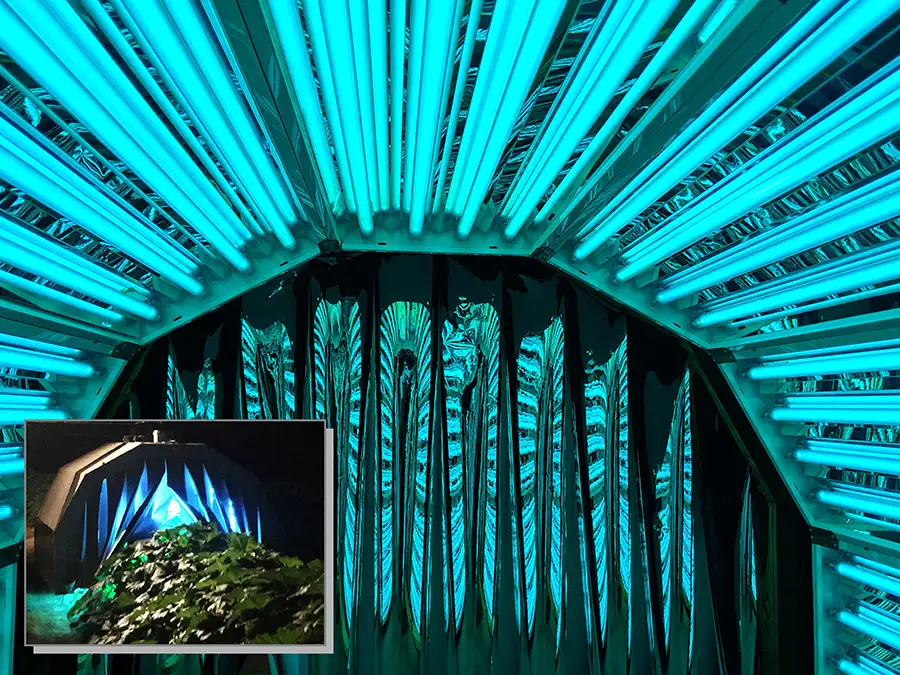
Until only recently, low-pressure discharge (LPD) lamps have been used in this research. 18 Although shown to be cost-effective in agriculture, research equipment in the US is custom-built for each pathogen, crop and geometry. Figure 1 shows a custom-built “Dragon” that was used to treat summer squash powdery mildew. In Europe, several for-profit companies use LPD lamps for controlling a variety of plant pathogens.
Although shown to be cost-effective with paybacks in less than three years, the problems with LPD Dragon systems are that they are large and bulky, and their lamps are breakable. Geometric considerations also make LPD lamps difficult to integrate into other farm equipment. Environmentally, LPD lamps contain mercury, which introduces the possibility of soil contamination for farmers. And just like conventional fluorescent lamps, LPD UV-C lamps also face increasing regulatory constraints on the use of products containing mercury. While germicidal LPD lamps may remain exempt from legislative efforts, the loss of market share for fluorescent lamps ultimately means that the luminaires and ballasts needed to operate LPD lamps likely will be phased out and certainly will become more expensive. Thus, any LPD-based farm equipment will be more costly, if not impossible, to maintain.
Field Study: UV-C LEDs for Agriculture
As previously noted, UV-C LPDs have been used successfully to control a wide variety of crop pathogens. Given the “handwriting on the wall” for the future of LPD lamps, the authors aimed to establish the benefits and drawbacks of using UV-C LEDs for controlling crop pathogens — in this instance, powdery mildew infections of acorn squash.
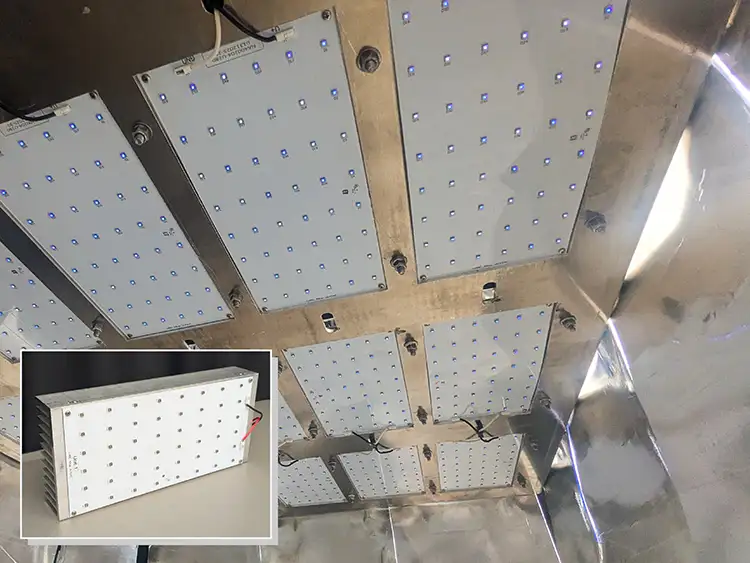
Unlike previous studies that used LPD lamps, this study was designed with standard UV-C LED “bricks” that could be used in a building-block design to deliver similar doses as the tractor-pulled LPD Dragons. Fabricated to the study’s technical specifications by three different manufacturers (ams OSRAM, Bolb and Nichia), the bricks were tested in the authors’ laboratory in 2025. 19
In close collaboration with the LHRC, a fabricator of custom farm equipment (LaGasse Machine & Fabrication, Lyons, New York) designed and built a tractor-pulled treatment apparatus that accommodates an array of standard UV-C LED “bricks” constructed by Nichia (Figure 2). Because the cost per milliwatt of UV-C radiation for the bricks was more than twice what was projected in the authors’ grant proposals, the newly constructed apparatus had to be smaller and therefore supply less radiant power than the LPD Dragon. Consequently, to provide an effective dose (i.e., values between 200 and 480 J m-2, as determined by previous studies 8), it was necessary to lower the tractor speed from that employed in the LPD studies. The fabricator also is a grower, so the nighttime field trials were conducted at the grower’s farm in the summer of 2025.
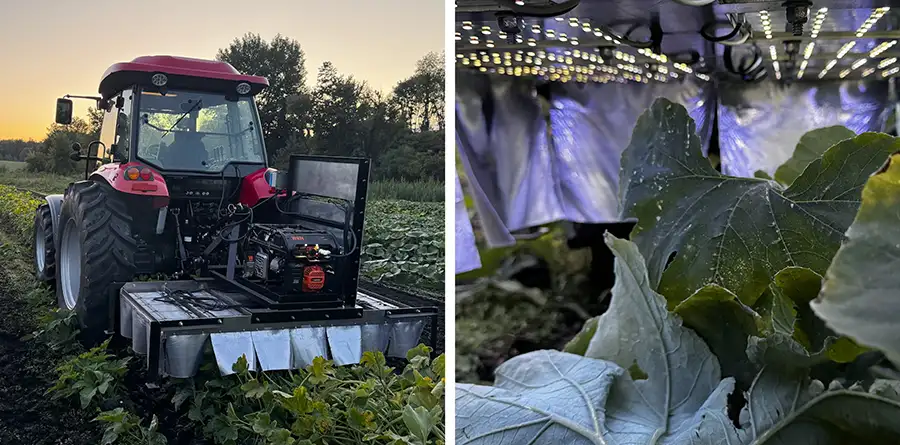
The treatment apparatus (Figure 3) housed 30 LED bricks in a simple, flat steel frame with mylar-coated curtains around its perimeter to contain the radiant flux. Each brick was powered by a separate driver connected to a single 5,500 W gasoline-powered generator. The entire apparatus was connected to a three-point hitch, allowing the grower to raise the array as the squash grew. Remote switches in the tractor cab afforded operational convenience while protecting the grower from exposure to UV-C radiation. It should be noted that the previous LPD Dragon lamps were shrink-coated with fluorinated ethylene propylene (FEP) sheeting material to ensure that any breakage would completely contain the quartz envelope and the mercury inside the lamps. FEP was not used in the LED field trial because the solid-state emitters contained no mercury, and this material would have absorbed roughly one-third of the radiant flux.
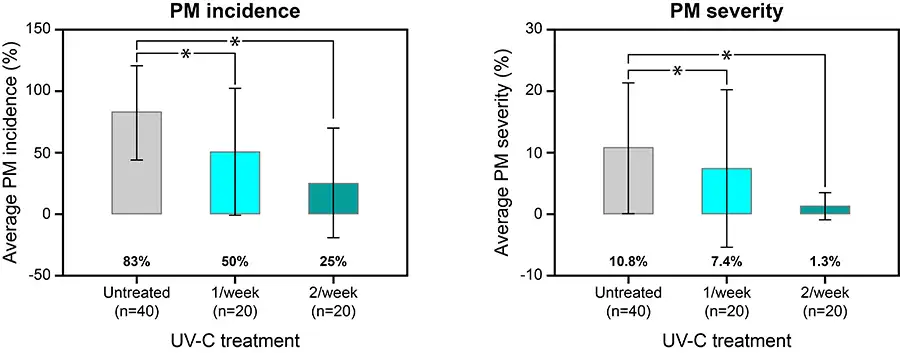
In collaboration with colleagues at Cornell University, the field trial evaluated the incidence and severity of powdery mildew (PM) caused by the fungal pathogens Podosphaera xanthii or Erysiphe cichoracearum. Cornell University plant pathologists Dr. Sarah Pethybridge and/or Dr. Frank Hay made weekly visits to the test plots from mid-July though early September 2025. Each week, they evaluated 20 leaves from each of the four, 200-foot test plots. In addition to their expert, subjective ratings of PM incidence, they used an objective technique to quantify disease severity; using photographs of each leaf, disease was analyzed using a smartphone app that analyzes a photo of a plant leaf to distinguish the ratio between healthy and diseased tissue. Both PM incidence and severity were improved significantly with UV-C treatment, with no statistically significant difference between one and two nights of treatment per week (Figure 4) according to pairwise comparisons using Tukey-corrected t-tests. The LED treatment apparatus showed similar effectiveness in controlling the same pathogen in a previous study employing the LPD-based Dragon to treat summer squash. 8 The farmer in the new study also noted that his UV-treated squash crop was much darker in color (indicating greater sweetness) and achieved considerably longer storage life (35 days). A technical report of the findings is forthcoming.
What’s Next for UV-C LEDs in Agriculture?
At this time, practical barriers to the use of UV-C LEDs in agriculture remain, perhaps principally with respect to cost and tractor speed. Compared to the LPD Dragons previously used to treat summer squash, 8 the 2025 UV-C LED apparatus cost about four times as much and operated at about half to one-third the speed. Future costs may be reduced by active engineering efforts on the part of manufacturers to increase external quantum efficiency and heat management that will bring about improvements to UV-C LED life, stability and price. 20, 21 Given LED technology’s annual trend of cost per milliwatt for general lighting, the authors expect UV-C LED prices to decrease as their efficiency increases. Further, heat management innovations, including active features such as air- or water-cooling, will be important to reduce weight, increase flexibility and improve efficiency, thereby enabling higher tractor speeds. However, slow tractor speeds and the fact that UV-C dosing is most effective at night (another potential limitation) might not be barriers in the near future; as the availability of farm labor becomes increasingly limited, 22 farmers are beginning to invest in autonomous robots, 23, 24 which may render late-night, slower speeds inconsequential.
Other barriers might not be so easily overcome. Farmers take pride in being self-sufficient, but are completely unfamiliar with UV-C technology, making maintenance less attractive and more difficult. Further, due to the non-visual nature of UV-C, any equipment failures may not be conspicuous to a farmer, so UV-C dosage measurements would be needed. As a result, the potentially lower life-cycle costs of UV-C LED technology may not in themselves convince growers to adopt the technology. To be successful, researchers, manufacturers and fabricators must make UV-C LED technology less challenging and more appealing to farmers.
Notwithstanding, given the rising cost and regulation of pesticides, as well as the technological improvements in UV-C LED technologies, the authors remain optimistic that these solutions will have a place in agriculture. Ongoing contributions at Mount Sinai to this transformation will continue to occur through measurement and field research, demonstrating both its benefits and drawbacks.
Acknowledgements
The authors wish to thank the New York Farm Viability Institute (#FVI 22 005) for supporting the UV-C LED brick development and field trials, as well as the USDA (NR222C31XXXXG004) for supporting the design and development of the tractor-pulled LPD Dragon. Thanks also to Erik Swenson of Nichia America Corporation, Frank Harder of Bolb, Inc. and Muhinthan Murugesu and Alexander Wilm of ams OSRAM Group. The authors are grateful to Dr. Sarah Pethybridge and Dr. Frank Hay of Cornell AgriTech for assessing disease symptoms. The technical assistance from Kevin Benner, Howard Ohlhous, Martin Overington and Nicholas Skinner, at the LHRC, as well as Andrew Bierman of Namreiba Consulting also is appreciated. The authors are particularly grateful to Larry Eckhardt of Kinderhook Creek Farms and to Ross Gansz, who served as both grower (Stone Goose Farms) and fabricator (LaGasse Machine & Fabrication).

Jennifer Brons has an M.S. in Lighting from Rensselaer Polytechnic Institute and over 30 years of experience throughout the lighting industry. Brons’ research has focused on field and laboratory studies of lighting technology, including disinfection systems. In addition to her design and research activities, Brons develops educational material about the effective use of light.

Dr. John D. Bullough is a program director at the Light and Health Research Center, part of the Icahn School of Medicine at Mount Sinai. In addition to agricultural research, he studies the effects of lighting on people and the environment in indoor and outdoor locations. Bullough has a Ph.D. in multidisciplinary science and an M.S. in Lighting from Rensselaer Polytechnic Institute.

Dr. Mark S. Rea is a professor in the Department of Population Health Science and Policy at the Icahn School of Medicine at Mount Sinai. He was formerly professor of Architecture and Cognitive Sciences at the Lighting Research Center (LRC) at Rensselaer Polytechnic Institute and served as LRC Director from 1988 to 2017. Dr. Rea is well known for his research in circadian photobiology, mesopic vision, psychological responses to light, lighting engineering and visual performance.
References
- Ristaino, J.B., Anderson, P.K., Bebber, D.P., et al. (2021). The persistent threat of emerging plant disease pandemics to global food security. Proceedings of the National Academy of Sciences. Vol. 118: No. 23. https://doi.org/10.1073/pnas.2022239118
- Onofre, R.B., Gadoury, D.M., Stensvand, A., Bierman, A., Rea, M.S., & Peres, N.A. (2021). Use of ultraviolet light to suppress powdery mildew in strawberry fruit production fields. Plant Disease 105: 2402-2409. https://doi.org/10.1094/PDIS-04-20-0781-RE
- Mello, P.P., Onofre, R.B., Rea, M.S., Bierman, A., Gadoury, D.M., Ivors, K., Ganci, M., Broome, J.C., & Peres, N.A. (2022). Design, construction, and evaluation of equipment for nighttime applications of UV-C for management of strawberry powdery mildew in Florida and California. Plant Health Progress 23:321-327. https://doi.org/10.1094/PHP-01-22-0002-RS
- Gadoury, D.M., Cadle-Davidson, L., & Gold, K. (2023). Use of UV light for suppression of grapevine diseases. 22nd GIESCO International Meeting, Cornell University, Ithaca, NY. https://ives-openscience.eu/wp-content/uploads/2023/07/Session-11_Gadoury_Use-of-UV-light.pdf
- Ledermann, L., Daouda, S., Gouttesoulard, C., Aarrouf, J., & Urban, L. (2021). Flashes of UV-C light stimulate defenses of Vitis vinifera L. ‘Chardonnay’ against Erysiphe necator in greenhouse and vineyard conditions. Plant Disease 105: 2106-2113. https://doi.org/10.1094/PDIS-10-20-2229-RE
- Yannuzzi, I.M., Gadoury, D.M., Davidson, A., & Cox, K.D. (2023). Applications of germicidal ultraviolet light as a tool for fire blight management (Erwinia amylovora) in apple plantings. Phytopathology 113: 2215-2221. https://doi.org/10.1094/PHYTO-05-23-0151-SA
- Pethybridge, S.J., Rea, M.S., Gadoury, D.M., Murphy, S., Hay, F., Skinner, N.P., & Kikkert, J.R. (2024). Nighttime applications of germicidal UV light to suppress Cercospora leaf spot in table beet. Plant Disease 108: 2518-2529. https://doi.org/10.1094/PDIS-12-23-2715-RE
- Bullough, J.D., Skinner, N.P., Patel, J.S., & Rea, M.S. (2025). Impacts of UV-C, leaf agitation and fungicide application on powdery mildew in yellow squash. Agricultura 134(1-2): 162-173. https://journals.usamvcluj.ro/index.php/agricultura/article/view/15166
- Skinner, N.P., Rea, M.S., & Bullough, J.D. (2022). Effectiveness of the field application of UV-C for cucumber downy mildew control. Journal of Horticultural Sciences 17: 424-435. https://doi.org/10.24154/jhs.v17i2.1429
- Nelson, K.L., et al. (2018). Sunlight-mediated Inactivation of health-relevant microorganisms in water: a review of mechanisms and modeling approaches. Environmental Science: Processes and Impacts 20(8): 1089-1122. https://doi.org/10.1039/C8EM00047F
- Sancar, A. (1994). Structure and function of DNA photolyase. Biochemistry 33(1):2-9. https://doi.org/10.1021/bi00167a001
- Suthaparan, A., Torre, S., Mortensen, L.M., Giselrød, H.R., Stensvand, A., Solhaug, K.A., & Gadoury, D.M. (2012). Interruption of the night period by UV-B suppresses powdery mildew of rose and cucumber. Acta Horticulturae 956:617-620. https://doi.org/10.17660/ActaHortic.2012.956.73
- Gates, F.L. (1930). A Study of the bactericidal action of ultraviolet light iii. The absorption of ultraviolet light by bacteria. Journal of General Physiology. 14: 31-42. https://doi.org/10.1085/jgp.14.1.31
- Marasini, S., Leanse, L.G., & Dai, T.H. (2021). Can microorganisms develop resistance against light-based anti-infective agents? Advanced Drug Delivery Reviews 175: 113822. https://doi.org/10.1016/j.addr.2021.05.032.
- Denton, C.R., Bunsen Lerner, A., & Fitzpatrick, T.B. (1952). Inhibition of melanin formation by chemical agents. Journal of Investigative Dermatology. Vol. 18, Issue 2, p119-135. https://www.jidonline.org/article/S0022-202X(15)48268-5/pdf
- Light and Health Research Center (LHRC) at Mount Sinai. (2025a). Annotated Bibliography: Use of UV-C to Combat Crop Disease in Real-World Field Studies. Accessed March 2026 at: https://drive.google.com/file/d/1bjqAknWZLuAZbv6rE7m_ill-po9x44x4/view?usp=sharing
- LHRC. (2025b). Annotated Bibliography: Use of UV-C to Combat Crop Disease in Greenhouse/Tunnel Studies. Accessed March 2026 at: https://drive.google.com/file/d/1ZMZ5MyPdN7B-y3_fbAp9B3DpE1Qs1ij0/view?usp=sharing
- Rea, M.S., Bullough, J.D., & Bierman, A. (2021). Output reduction over time of germicidal UV-C lamps used for treating agricultural crops. Leukos, the Journal of the Illuminating Engineering Society Volume 18: Issue 4. https://doi.org/10.1080/15502724.2021.1921594
- LHRC. (2025c). Advanced UV LED Technology to Reduce Fungicide Use in Organic Farming. Report prepared by the Light and Health Research Center, Icahn School of Medicine at Mount Sinai, for the US Department of Agriculture.
- Li, M. (2025). UV-LEDs: Next-Generation Ultraviolet Light Sources. Fundamentals of LED Technology. Intech Open. https://doi.org/10.5772/intechopen.1012869.
- Wilm, A., Leirer, C., Lugauer, H.J., & Hoffmann, M.P. (2022). UV-C LEDs and their use in disinfection applications. International Society for Optics and Photonics (SPIE) Conference: Light-Emitting Devices, Materials, and Applications XXVI. https://doi.org/10.1117/12.2608513
- Rutledge, Z. & Win, M.T. (2026). Findings from the California Farmer Immigration Enforcement Survey. Staff Paper Series 396210, Michigan State University, Department of Agricultural, Food, and Resource Economics. https://doi.org/10.22004/ag.econ.396210
- Lowenberg-DeBoer, J. (2022). Economics of Adoption for Digital Automated Technologies in Agriculture. Background paper for The State of Food and Agriculture 2022. FAO Agricultural Development Economics Working Paper 22-10. Rome, FAO. Food and Agriculture Organization of the United Nations. https://doi.org/10.4060/cc2624en
- Castillo, A. (2025). Automation at the National Farm Machinery Show. Farm Equipment and Machinery, Farm Progress. Accessed March 2026 at: https://www.farmprogress.com/farming-equipment/automation-at-national-farm-machinery-show