

By Paolo Di Lazzaro, Sarah Bollanti, Antonia Lai and Daniele Murra, ENEA Frascati Research Center; Loretta Bacchetta, ENEA Casaccia Research Center; and Simona Lucioli, CREA, Research Centre for Olive, Fruit and Citrus Crops
In the farming systems of tomorrow – where sustainability and productivity must go hand in hand – plants should not simply be treated, but strengthened. This is the idea behind hormesis: a forward-thinking approach that uses ultraviolet (UV) light to stimulate and enhance the plant’s own defense mechanisms, reducing the need for pesticides while improving crop quality and consumer health. At present, amalgam mercury lamps dominate the market for UV-C sources suitable for generating the hormetic effect in crops. However, UV-C LEDs offer several advantages over lamps, and if their cost continues to fall over time, they could play an important role in the future of precision agriculture.
Motivation
Pesticides are one of the main health concerns worldwide. In recent years, global pesticide use has been around 3.73 million tons of active ingredients, which is a 14% increase over the last decade and double the amount used in 1990. This means an average of 2.4 kg per hectare of cultivated land. 1
Unfortunately, pesticides cannot be eliminated completely by observing waiting periods or washing crops. Consequently, every time individuals drink a glass of beer or wine, or eat plant-based or animal-based foods (for example, from animals that feed on plants), they may ingest a significant amount of pesticides that can have long-term consequences for health. The ideal solution to this problem should be low-cost and as effective as pesticides, without adverse side effects on health and without reducing crop yield and quality. At present, no such ideal solution exists, but UV-driven hormesis – described in the following – can meet three of the four requirements: It is effective enough to drastically reduce the need for pesticides, has no adverse health effects and does not reduce crop quantity or quality.
UV Hormesis, a High-Tech Solution
It is known that low doses of UV-A and UV-B light emitted by the sun have a beneficial effect on plant growth. Conversely, UV-C light, which does not reach Earth due to absorption in the atmosphere, could cause stress to fruit/plants. However, when used in appropriate doses, stress induced by UV-C radiation does not cause permanent damage but instead stimulates plants to react by biosynthesizing secondary metabolites (e.g., phenolic acids, carotenoids, flavonoids) that have antioxidant and antimicrobial activity. This side effect of moderate stress caused by UV-C rays increases resistance to pathogens for extended periods of time. The biological adaptive reaction of the plant to UV-C stress is called the “hormesis effect.”
Hormesis is a dose-response phenomenon, so it is essential to determine the UV dose value accurately. The optimal hormetic dose depends on the specific genotype of the plant and on its phenological stage, as well as on the environment and the pathogen. This is why hormetic dose values reported in the literature may differ from one another.
Experimental
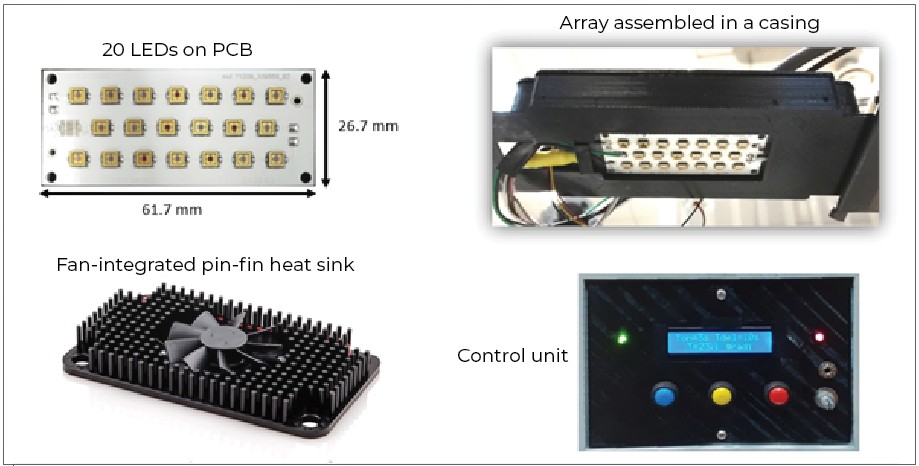
The ENEA Research Center in Frascati assembled and characterized two UV-C LED arrays, comparable in size to a cell phone (Figure 1).
A constant current power supply, designed and assembled using the authors’ in-house expertise, was used. To find the optimal spatial arrangement of LEDs to ensure uniform irradiation on the target, a dedicated ray-tracing code was developed that allowed for obtaining, at any point in space, the intensity value emitted by a combination of point light sources distributed over arbitrary surfaces, based on their power and angular radiation profile. The results of the ray-tracing code are in perfect agreement with the experimental results.
Results
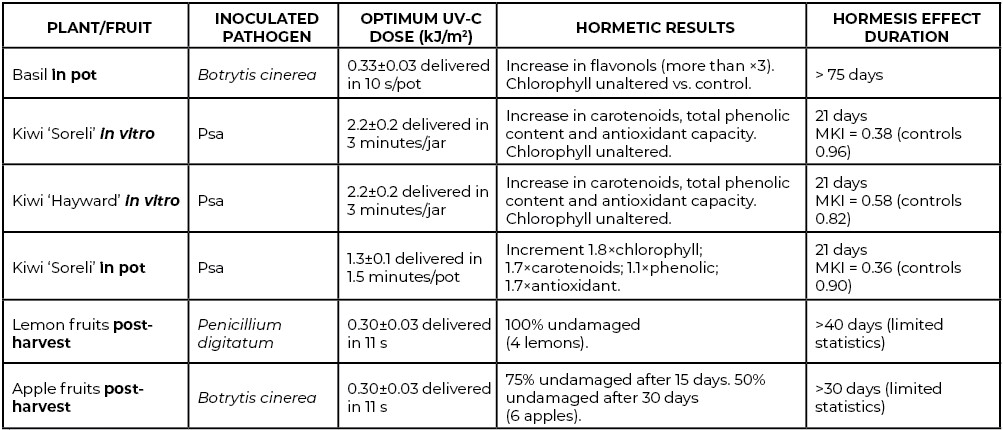
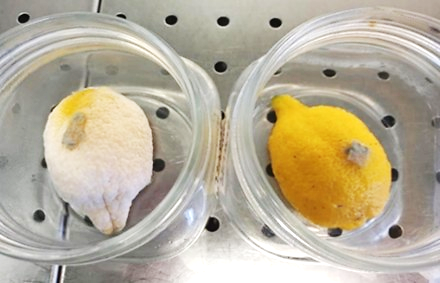
The authors found the optimum UV-C dose apt to generate the hormetic effect on post-harvest fruits and pre-harvest plants against some of the most aggressive pathogens, including those for which there currently are no effective countermeasures: i.e., Botrytis cinerea, Penicillium digitatum, Pseudomonas syringae pv. Actinidiae (Psa). Detailed methods, set-up and results are available in the peer-reviewed papers listed in the Resources. Table 1 shows a summary of the main results. Dose values were measured by an accurate procedure using two absolute power meters. In Table 1, the authors used the standard McKinney index (MKI) – an international benchmark to evaluate the severity of visible symptoms induced by the infection – defined as MKI (%) = {[Σ (c·n)]/N}·(100/C), where c is the value of the infection class, n the number of samples belonging to the same class, N the total number of samples and C the maximum value of the rating scale.
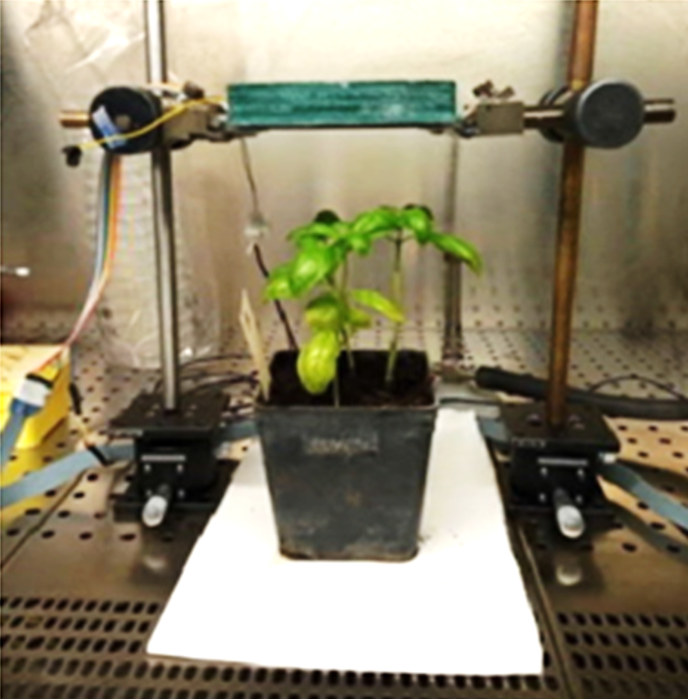
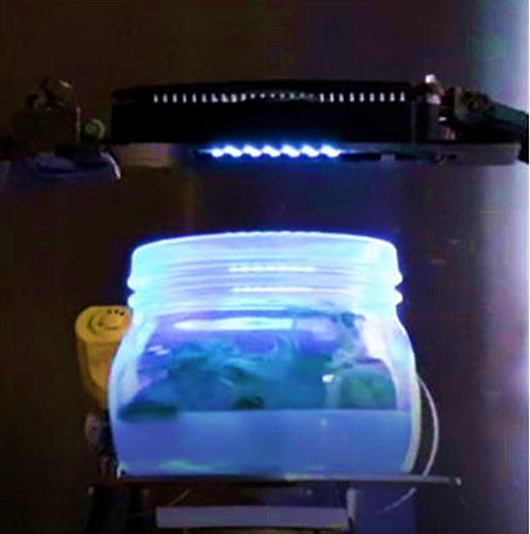
By way of example, Figures 2, 3 and 4 show the UV-C irradiation of a potted plant, an in vitro plant and a post-harvest fruit, respectively.
Conclusion
The authors presented two UV-C emitters made by 20 and 38 LEDs, driven by a constant-current power supply, designed and assembled through ENEA’s in-house expertise. The total cost of the components for each prototype is $450, while a mass-produced version would cost much less.
The design of the arrays was based on dedicated software that calculates, at any point in space, the value of the intensity of light emitted by a combination of point light sources distributed over arbitrary surfaces, depending on their powers and the angular radiative profile.
Both LED arrays have been used for various germicidal and hormesis applications. This paper described the generation of the hormesis effect in plants and in post-harvest fruits by determining the optimal individual UV-C dose to generate the abiotic immune response against aggressive pathogens, including those for which there currently are no effective countermeasures.
Tests show that preventive irradiation by UV-C LEDs allows biosynthesis of defensive metabolites with antioxidant and antimicrobial activity that enhances the resistance of plants and fruits to pathogen attacks. The hormesis effect has proven effective in limiting crop diseases both pre- and post-harvest, without harming plants or the environment.
The authors’ work was conducted in the laboratory, under controlled conditions and using advanced diagnostics, in order to obtain reliable optimal dose values. The next step is to conduct in-field tests, using larger LED arrays to evaluate the implementation of LEDs on agricultural crops as an alternative to UV-C mercury lamps already used for sustainable integration of chemical pesticides. LED arrays can be assembled into modular systems and driven in parallel, allowing the overall size and shape of the LED light source to be adapted to specific requirements. The use of LED arrays in open-field irradiation is facilitated by the availability of automated, unmanned irradiation systems that currently use amalgam mercury lamps, since replacing these lamps with LED arrays is straightforward and requires only a modification to the electrical power supply system. All parameters of the irradiation equipment (dimensions, hardware, travel speed, remote control, etc.) remain virtually unchanged.
This effort makes sense both for the obvious advantages of using a solid-state light source over a gas discharge source (larger average lifespan, stable performance over time, immediate full brightness upon switching on, resistance to shock and vibration, lightweight, low-voltage operation that allows compact power supply) and to avoid the problems with disposal of mercury and potentially toxic metals at the end of the lamp’s life. If the cost of UV-C LEDs continues to decrease, they will become competitive with mercury lamps and could play an important role in the future of precision agriculture.
Since the optimal dose of UV-C to generate the hormetic effect depends on the species, the authors emphasize the importance of a database that lists the minimum effective UV-C doses for each plant, fruit and pathogen. The use of this database should be based on doses measured by absolute UV-C detectors and not extrapolated from the technical data sheets of LEDs or mercury lamps.
This research was presented at the World Congress IUVA in Lisbon, Portugal, in September 2025. Paolo Di Lazzaro, physicist, worked for 39 years at ENEA, the Italian National Agency for New Technologies, Energy and Sustainable Economic Development, developing coherent and non-coherent UV light sources. Loretta Bacchetta, agronomist, is a senior researcher at the ENEA center of Casaccia, Rome, Italy, and works on crop genetic resources and quality assessment (secondary metabolites, spectrophotometric analysis) of food and non-food plant systems. Sarah Bollanti, physicist, is director of research at the ENEA center of Frascati, Italy, working on the characterization of UV light sources and their applications. Antonia Lai, biologist, is director of research at the ENEA center of Frascati, Italy, and works on spectroscopy techniques that analyze the quality, security and safety of plants and food. Simona Lucioli, biologist, is a researcher at CREAOFA, the Council for Agricultural Research, in Rome, Italy, working in the Laboratory of In Vitro Plant Cultures. Daniele Murra, physicist, is director of research at the ENEA center of Frascati, Italy, working on the characterization of UV light sources and their applications. For more information, contact paolo.dilazzaro14@gmail.com.
References
- Food and Agriculture Organization of the United Nations. 2025. FAOSTAT: Pesticides use. https://www.fao.org/faostat/en/#data/RP.
- Bollanti, S., et al. “Design, realization, and test of ultraviolet-C LED arrays suitable for long-lasting irradiation of biological samples.” Machines, vol. 11, 2023, pp. 792–804, https://www.mdpi.com/2075-1702/11/8/792
- Di Lazzaro, P., et al. “Pathogen growth inhibition in Ocimum basilicum (L.), Malus domestica (Borkh.), and Citrus limon (L.) by low-dose UV-C LED exposure.” Annals of Agricultural & Crop Sciences, vol. 9, 2024, p. 1144, https://austinpublishinggroup.com/agriculture-crop-sciences/fulltext/aacs-v9-id1144.php
- Lucioli, S., et al. “Ultraviolet-C light effects in Actinidia spp. infected by Pseudomonas syringae pv. actinidiae.” Horticulturae, vol. 10, 2024, pp. 944–959, https://www.mdpi.com/2311-7524/10/9/944
- Ben Sedrine, N., et al. “UV light, an ecofriendly abiotic ‘vaccine’ for plants?” UV Solutions, fourth quarter 2024, pp. 12–15. ISSN 1528-2017, https://uvsolutionsmag.com/articles/2024/focus-on-food-and-beverage-safety-uv-light-an-ecofriendly-abiotic-vaccine-for-plants/