

By David Bustos, University of Chile
Editor’s Note: This article is based on the author’s MSc thesis, which discusses the topic more extensively. 1
The European Union is progressively phasing out mercury-based technologies to protect human health and the environment. This policy directly impacts water utilities in the Netherlands, where ultraviolet (UV) disinfection via mercury lamps has been the backbone of drinking water safety for the past 20 years. Therefore, Dutch utilities must find a replacement for their mercury-based UV disinfection systems before they are permanently banned. UV LEDs are a promising alternative because of their compactness, wavelength flexibility, instant on/off operation and a lower environmental footprint. However, their feasibility for full-scale water disinfection in the Netherlands remains unclear due to questions about their germicidal performance, required surface area and energy efficiency. To address these uncertainties, two reactor designs were modeled and benchmarked against three real-world mercury reactors in Flanders and the Netherlands.
Research Approach
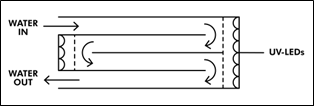
The study focused on two reactor designs:
- Circular Cylinder Reactor (CCR): a design based on scientific literature, in which water flows through a meandering cylindrical pipe (see Figure 1). UV LEDs mounted at the ends of the pipe emit collimated beams parallel to the flow.
- Square Prism Reactor (SPR): a design based on existing UV LED reactors, in which water passes through a square channel (see Figure 2). UV LEDs mounted on the lateral walls emit collimated beams perpendicular to the flow.

As for the production of collimated beams, the models used Mohaghegh Montazeri & Taghipour’s (2022) optical module, consisting of a reflector with a diameter of 3.32 cm, a depth of 3.45 cm and a collimating efficiency of 95%. The models were implemented in MS Excel considering flow rate (Q), UV transmittance (UVT), UV LED power (P), target fluence (F) and other parameters of interest. They were set to replicate the design flow rate and fluence of three real-world, 254 nm mercury-based UV reactors. These real-world disinfection systems belong to three drinking water treatment plants (DWTPs) in Flanders and the Netherlands, which have been anonymized as DWTP A, DWTP B and DWTP C (see Table 1). The most powerful and efficient commercially available UV LED in the Netherlands at the time of the study was used as input to run the models. This UV LED has a wavelength of 265 nm and an output power of 115 mW with a wall-plug efficiency (WPE) of 5.3%. For reference, the output power of proprietary UV LEDs used in state-of-the-art reactors is around 200 mW, with a WPE between 7%-10%. Therefore, the models underestimate the performance of high-end UV LED reactors.
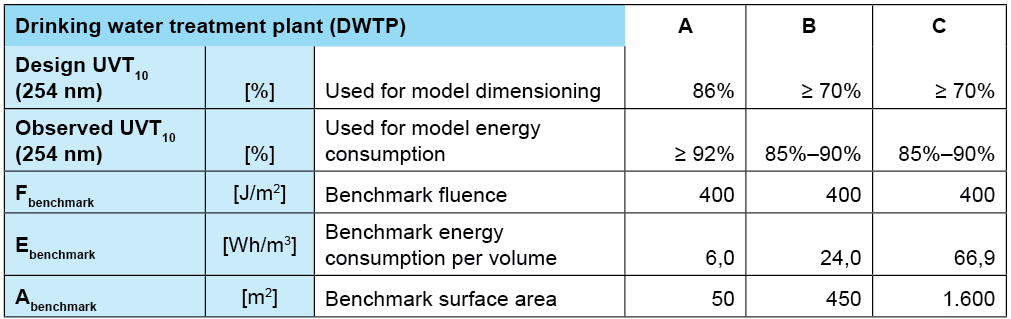
There is a threefold difference between the energy consumption per cubic meter of DWTPs A and B, and an eightfold difference between the energy consumption per cubic meter of DWTPs A and C. To validate this information, the system specifications of the UV reactors used by the three DWTPs surveyed were reviewed. Their respective data sheets showed energy consumption values that are similar to those reported by the surveyed DWTPs.
Design UVT10 is the minimum UV transmittance that a DWTP can support to meet its disinfection requirements, while observed UVT10 is the UV transmittance that typically is measured under normal operating conditions. The importance of making a distinction between design UVT10 and observed UVT10 is that while a modeled reactor should deliver the target fluence under design conditions, it also should be efficient under observed conditions.
Because UV transmittance (UVT) for wavelengths other than 254 nm were not provided by the water utilities, drinking water samples were taken in May 2025 from residential taps in Delft, Nieuwegein, and Utrecht Science Park (USP) for UVT profiling at Utrecht University‘s GeoLab. These measurements were used to estimate UVT10-265 (relevant for Osram’s UV-LED peak wavelength of 265 nm and fluence calculation) from UVT10-254:
UVT10-265 = UVT10-254 + 0.7%
As a design criterion, flow velocity in the modeled reactors was kept between 0.5-1.0 m/s to prevent stagnation and to minimize friction losses, respectively. For the meandering reactor model (CCR), the ratio of flow channel length to internal pipe diameter was set to be at least 6:1 to prevent short-circuiting. The surface area of the modeled reactors was estimated by adding up the pipes and channels needed to deliver 400 J/m2 and then dividing the resulting area by a stacking factor. Because many modeled UV LED reactors are needed to replicate the performance of the disinfection systems surveyed, stacking them, as is generally done with reverse osmosis systems, was considered to optimize space. The vertical spacing between reactors was set to 15 cm, and the maximum height of the stacked reactors was kept below 2.00 m to facilitate inspection and maintenance.
Results
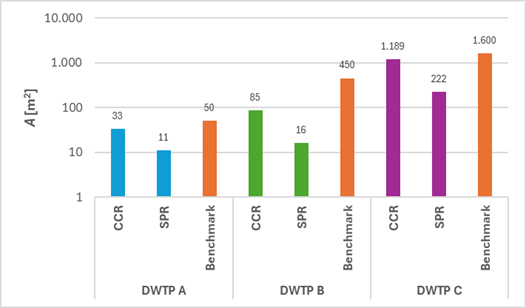
Figure 3: Benchmarking: surface area
The models were benchmarked against the three real-world DWTPs in terms of required surface area and energy efficiency. The benchmarking results show that both the CCR and SPR models theoretically can match or outperform their real-world counterparts in terms of required surface area (see Figure 3). However, only the UV reactor models based on DWTP C were more energy efficient than their real-world counterpart (see Figure 4). The CCR models could match the energy efficiency of their real-world counterparts if the wall-plug efficiency (WPE) increased to 14.8% and 7.5% for DWTPs A and B, respectively. On the other hand, the SPR models could match the energy efficiency of their real-world counterparts if the WPE increased to 15.1% and 7.6% for DWTPs A and B, respectively.
Discussion
Energy efficiencies ranged between 16.7-34.4 Wh/m3 in the CCR and SPR modeled reactors, and between 6.0-66.9 Wh/m3 in the surveyed reactors, provided the data reported by the DWTPs is accurate. More specifically, all the modeled reactors were less energy efficient than the real-world reactors of DWTPs A and B, but more efficient than those of DWTP C. As expected, the reactors that disinfected water with the highest UV transmittance (UVT) were the most energy efficient. These results position the energy efficiency of the modeled reactors between that of the surveyed reactors, although the latter generally are more efficient. However, if the wall-plug efficiency (WPE) of the modeled reactors was increased from its original 5.3% to 7.5%-15.1%, then all the modeled reactors would match or outperform their real-world counterparts in terms of energy efficiency.
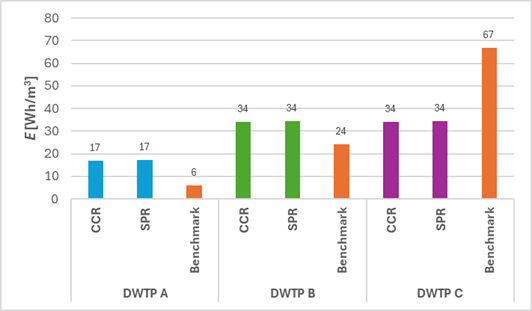
Figure 4: Benchmarking: energy efficiency
A comparison between the performance of the SPR design (meandering channels) vs. the CCR design (single straight channel) shows that they have an almost identical energy efficiency under equal working conditions. However, the SPR design requires between a fifth and a third of the surface area compared to the CCR, making it less space-intensive. This is because the 6:1 ratio of flow channel length to pipe diameter in the CCR – designed to prevent short-circuiting – also creates a “dark zone” in the middle section of the flow channels, where barely any fluence is delivered. The CCR also would need additional validation to check if short-circuiting is happening at the bends of the meandering channels, where fluence actually is delivered.
Considering that proprietary UV LEDs already have reached a wall-plug efficiency (WPE) of 10%, then the CCR and the SPR designs already could match the energy efficiency of real-world UV reactors in some scenarios. It would be only a matter of time until UV LED technology evolves to a point where these reactor designs could match their real-world counterparts in most, if not all, foreseeable scenarios.
While these results confirm UV LEDs as a promising alternative to mercury-based lamps, it is worth mentioning that modeling was done assuming ideal conditions, meaning that actual reactor performance and efficiency likely would be lower than those presented in this article. Furthermore, a more accurate assessment of energy efficiency in real-world DWTPs is required to draw stronger conclusions. Future research should use prototyping, computational fluid dynamics (CFD) or other advanced methods to simulate or check for UV light scattering, fluence delivery, fluid mechanics, flow mixing, short-circuiting, system cooling, head loss, the effect of using collimated beams vs. non-collimated beams and the cost-effectiveness of the reflectors to produce such beams. The possible advantages of using reflective material inside reactors based on collimated beams also should be considered.
Conclusion
As the European Union progressively bans the use of mercury in its member states, and in light of the results of this research, UV LEDs would need to increase their wall-plug efficiency (WPE) above 15% to match or outperform the energy efficiency of any of the Dutch mercury-based reactors surveyed. Considering that UV LED output power already is high enough to perform well in water disinfection, the main technological challenge would be to improve wall-plug efficiency rather than making UV LEDs more powerful.
Finally, the SPR design is – within the scope of this research – the overall best UV LED alternative to mercury-based reactors, offering competitive energy efficiency at the lowest possible surface area. This is consistent with the UV LED industry, as the SPR is similar to the design currently preferred for full-scale UV LED disinfection. However, regardless of the reactor design chosen, other parameters such as costs, cooling, lifetime, monitoring and comparison to other disinfection technologies should be studied before proclaiming UV LEDs as the most promising alternative to mercury-based lamps in the Netherlands or any other country.
Reference
- UV LEDs for Drinking Water Disinfection in the Netherlands as an Alternative to Mercury-Based Lamps, https://studenttheses.uu.nl/handle/20.500.12932/49452

David Bustos is a civil engineer from Chile with over 10 years of experience in water tariff and other projects related to drinking water and sanitation. Bustos recently earned a MSc in water science and management from Utrecht University. His thesis explored the feasibility of UV LED technology in the Netherlands. For more information, email dbustos@ing.uchile.cl.