

By Tonnie Telgenhof Oude Koehorst, Nedap
Optimizing UV Performance of Low-Pressure UV lamps
Low-Pressure (LP) amalgam lamps currently are the primary source of UV-C light used in water and air disinfection systems. Globally, the number of UV-C lamps installed in disinfection units is in the millions. This widespread deployment underscores the importance of optimizing every component in these systems for energy efficiency.
Lamp-type UV sources now exhibit UV efficiencies between 11% and 40% (low-, medium-pressure and DBD lamps). UV-C LEDs are up to 7.5% but still a far way from reaching the same (35 to 40%) UV efficiency, especially for large-scale industrial and municipal water treatment plants.
Additionally, for Low-Pressure UV lamps, now available up to 1000 W, there still is improvement possible in UV efficiency by energizing the lamp in the right way.
Operation of Low-Pressure Mercury Lamps

During ignition and the initial warm-up phase, a Low-Pressure mercury lamp rapidly increases its UV-C radiant flux until it reaches the maximum output level. After this point, the effective efficiency declines (see Figure 1) as a function of several operational and physical parameters, including:
- Lamp temperature: Influences mercury vapor pressure and optimal discharge conditions
- Lamp Current: Affects plasma stability and electrode loading
- Operating Frequency: Determines discharge dynamics and power transfer efficiency
- Waveform Characteristics: Deviations from optimized drive waveforms reduce conversion efficiency
- Lamp Lifetime (aging effects): Electrode degradation, mercury consumption and coating deterioration progressively reduce UV-C output.
So, there is one key shared parameter between lamp and power supply that still offers room for improvement in UV-C output: the frequency (and shape) of the electrical current.
Frequency Dependence of UV-C Efficiency
The relationship between UV-C efficiency and frequency in LP lamps was studied extensively in the 1960s through both experimental and theoretical work. 1 The resulting theoretical models aligned well with experimental data and helped establish the foundation for the design of modern electronic drivers.
The frequency spectrum of a plasma current in an LP lamp can be divided into four characteristic regions:
0 < ω << 1/tD tD: Time constant of ambipolar diffusion. In this low-frequency range, the discharge behaves like a slowly varying DC discharge.
1/tD << ω << 1/tHg tHg: Lifetime of excited mercury atoms. In this intermediate range, frequency modulation affects the electron temperature, resulting in reduced UVC output compared to DC.
1/tHg << ω << 1/te This range yields the maximum electron temperature, enhancing mercury atom excitation and maximizing UVC emission.
ω >> 1/te te: Relaxation time of electron energy. At very high frequencies, discharge parameters (e.g. electron temperature, concentration) remain constant, similar to DC behavior.
Where ω=2πf and f is the frequency of the energizing lamp voltage/current.
These frequency ranges show that changing the current frequency – while keeping input power constant – either can increase or decrease UV-C output.
Implications for Electronic Power Supplies
Most commonly used electronic drivers operate in the optimal frequency range 3 (1/tHg << ω << 1/te), typically between 30 and 60 kHz. However, their output current waveform is not a pure sine wave – it contains harmonics. These harmonics often fall outside the optimal region and into range 4, which corresponds to discharge conditions similar to DC operation.
As a result, these harmonics do not contribute to increased UV-C output and thus reduce the system’s overall efficiency.
To investigate the influence of higher-order harmonics on the ultraviolet (UV) efficiency of a low-pressure mercury lamp, an experimental set-up was developed that employed a waveform generator and a power amplifier. The lamp was operated at a constant frequency and power level, while the waveform shape was varied between sinusoidal and triangular forms. UV-C radiation output was measured under identical conditions, using the same lamp, configuration and UV sensor to ensure consistency.
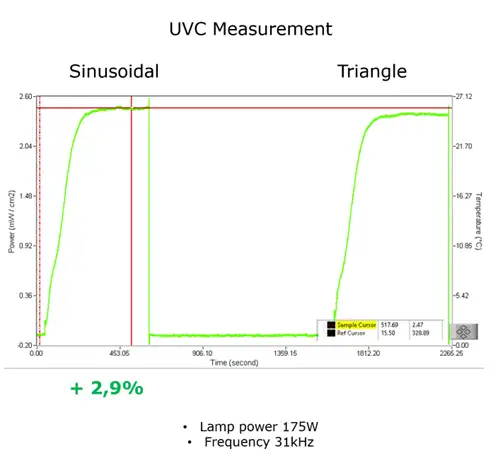
As illustrated in Figure 2, the sinusoidal waveform yielded a 2.9% higher UV output compared to the triangular waveform. Comparable results were obtained using commercially available electronic drivers that produced waveform shapes nearly identical to those in the initial tests: sinusoidal and triangular. This second round of tests was conducted using the same lamp at a power level of 330 W. The lamp current was adjusted to the same level – within a 0.5% difference – by using the dimming functions of both drivers. The operating frequencies are determined by the design of the two drivers and were measured at 50.8 kHz and 39.7 kHz. Both frequencies fall well within the optimum operating range (1/tHg << ω << 1/τe). Again a 2.9% higher UV output was measured.
Conclusion
While UV-C lamp and driver efficiency have plateaued in terms of traditional optimization, current waveform design and frequency control present a critical remaining lever for improving UV-C output. Designing power supplies that maximize operation within the optimal frequency window – and minimize harmonic distortion – can lead to meaningful gains in energy efficiency and disinfection performance.
Editor’s Note: This paper was presented at the IUVA Conference, Lisbon, September 2025.
Acknowledgements
The author wishes to acknowledge Jürgen Bomers, Rudy Norder and Patrick Boink (Nedap R&D); Alex Voronov (Excelitas) and P.K. Swain and Jim Raymont (EIT 2.0) for their valuable contributions and support.
Reference
- dr. Chr. Meyer and ir. H. Nienhuis, “Discharge Lamps.” Philips Technical Library, 1988

Tonnie Telgenhof Oude Koehorst is the director, Global Sales and New Business UV at Nedap N.V., with more than 42 years of experience at Nedap and deep expertise in power systems for UV lamps used in water, air and surface treatment, as well as curing applications. Nedap has over 30 years of experience in designing and manufacturing intelligent, sustainable power solutions and is the world’s leading company in UV lamp driver technology. For more information, visit www.nedap.com.